Friday, June 22, 2007

The dreams of the boy are those of the man.

I staggered out of bed this morning, grumpy, drowzy, stiff, barely articulate and fiercely reluctant to go to school. I arrived bang on eight, only to be greeted by the Principal and told that my lessons were cancelled, and my presence wasn't required. He was actually quite embarrassed that my company hadn't been contated to let me know. Naturally, I was very understanding, and not in the least bit cross. What a great start to the weekend.

Labels: , , , ,

Thursday, May 17, 2007

Rapture

To my profound joy, a couple of my second year boys have hit upon the hilarious revelation that my name, with regards to the Japanese rendering of Western words, is but two syllables away from "clitoris." That they excercise their discovery with such regularity makes me hope they might actually start learning some new words...but I'm not holding my breath.

Labels: , , , ,

Thursday, April 05, 2007

入学生

Their uniforms are pristine and slightly ill-fitting. Their dazzling white trainers squeak on the shiny floor of the gymnasium. They are absolutely tiny and some are clearly wary of me. It's funny that when I saw some of these students in Elementary School, they seemed too big and in need of getting into Junior High very quickly indeed. Now this has been accomplished, they still look out of place, but in a different way. I look forward to embarassing them in class.

Labels: , , ,

Friday, March 09, 2007

Another Graduation...

The year seems to have passed in the blink of an eye, but at the same time dragged like a leaden coat and tails. The proceedings were just as emotional as last year, but we were graced with no less than three teachers wearing Hakama. Pictured is Endo Sensei, a teacher of Japanese who sits next to me, and one of the special needs teachers, whose name I haven't caught yet.


As is the way with these things, everybody filed into the ostentatiously decorated gym, applauded whilst one hundred and fifty students marched slowly to their seats (by the end of two out of four classes, I was desperate to stop clapping), possibly daydreamed whilst those same students were presented with certificates, and almost certainly fell asleep during the Koucho sensei's (Principal's) speech. Notable this year was the fact that the farewell procession of sobbing third graders went out through the sports ground. By the time that had been organised, most of them had cheered up.


I signed a lot of year books, posed for an inordinate number of pictures, had a very tasty bento, complete with sekihan (rice steamed with sweet red beans) and then...nothing...

Long term readers of this blog will be aware of my most common complaint with work. For those of you who have come here by accident (and have made it this far), regardless of my workload or the actual presence of students, I'm required to stay on school grounds until 4:30. Usually I use this as an opportunity to really hammer my Japanese studies, but today (and days like it in the past) a cloudy block descended, rendering me incapable of concentration due to the sheer absurdity of it all. Why was I there? What purpose did it serve?

I sat there for a while and actually managed to get a bit of study done, but that niggling sense of being able to do it at home kept knocking. Then teachers started leaving at the morally reprehensible time of 2:30, and I began to question my sanity.

At the end of each day, I'm supposed to get a stamp on my time sheet from the Vice Principal (Kyoto Sensei). At Elementary School, where I usually finish at 1pm, I can coax permission to leave from the Kyoto by handing them my time sheet for the stamp, which invariably ellicits the salutation "O tsukare sama deshita," which literally means "honorific tired person was" and kind of means "very good day at work, you must be tired, (I'm) go(ing) home". Faced with another couple of hours of enraged thumb twiddling, I readied my paperwork for the walk up to the Kyoto's desk, only to be stopped by one Kamihara sensei, a Social Studies teacher for whom I have tremendous respect, not least of all for his affable charisma, who suggested we go to the gym and practice Kendo. Strike me down with a bamboo sword if I didn't say yes.

Kendo, simply put, involves donning cumbersome and visibility-reducing armour, before bashing your opponent with a big stick and shouting at them. There are three strike points, the head, wrist and body (or rather, right hip). Kamihara sensei is very good.

Kendo might look simple, but precision is the key. Kamihara sensei was really walloping me - I could feel it with the blows he rained down on my head - but I emerged relatively bruise free. The armour is pretty solid, and a direct hit will do little more than ring in your ears. I however have all the precision of a rabid elephant on a motorcycle, as Kamihara sensei's right hip can no doubt testify.

That done, he suggested we have a bout of Aikido which I am genuinely interested in. Quintessentially a self defense martial art, Aikido relies upon using the energy expended by potential attackers back on themselves. Kamihara sensei is also remarkably good at that, flooring me several times during our spat. I returned to the teachers room an hour later, sweaty, bruised and in the highest of spirits...

...until the Kyoto sensei (who can't speak a lick of English) asked an English teacher what I was doing today. That ruffled me a bit because I can actually speak Japanese. Said English teacher didn't ask me, rather she said she didn't know, and we should ask a different English teacher. Bear in mind that I am within spitting distance of these people. Off goes the Kyoto to find this other teacher, whilst I ask the English teacher if there was anything I could help with. She looked me in the eye and shook her head. I held my gaze, and she eventually came clean, not that there was anything to bloody well come clean about - grrr! I hate this country sometimes.

Peculiar day, highs, lows, tears, laughter, civility, lack of and bashing people with sticks. I'm going out with Hayley for her birthday.

Labels: , , , , , , , ,

Tuesday, February 20, 2007

In defence of Native English Speakers in Japanese schools.

Mary Newton has recently written a rebuke of an article which appeared in the Daily Yomiuri on the 9th of February. Within, James W. Porcaro, Professor of English as a Foreign Language at Toyama University of International Studies, calls for an end to the Assistant Language Teacher (ALT) program (provided by JET and various private companies) on the grounds that it is a massive waste of money with little in the way of observable benefits.

The basis for his argument is a pessimistic criticism of Michael Auslin, a former ALT (from 1991-'92) who, as Prof. Porcaro neglects to mention, is himself a Professor at Yale. The picture Porcaro paints from Auslins remarks that he had "few responsibilities" and "a lot of fun", combined with his own opinions that the "fun and games" had by students in English class are in fact "detrimental" portrays ALT's as workshy graduates, looking for one more opportunity to slack off before they have to find jobs. Porcaro states that Auslin, and a total of 9,000 ALT's,

"...continue to demonstrate the same lack of educational value...at an annual cost of about 50 billion yen to Japan's taxpayers."

In an ideal situation, ALT's and their counterparts, the Japanese Teachers of English (JTE's) are supposed to present a "double act" in order to put an emphasis on communication, rather than learning grammar by rote, which doesn't necessarily aid conversation skills. The core of an effective English lesson with a JTE and an ALT is a good working relationship, but this isn't always possible for a variety of reasons.

For starters, I've been visiting four schools this year. No matter how good your relationship with the JTE is, it is impossible to be a consistent benefit to the students, because every other week, the ALT goes to a different school. When they return, the students and the JTE have adopted a routine that works without the ALT because they aren't there most of the time. Efforts are made to include the "guest", but usually these don't stray beyond the "human tape recorder" phenomenon.

Elaborating on the JTE/ALT relationship, very often, even with the most experienced JTE, they still make obscene errors of grammar. Some JTE's are hardly the "models of English-language" Porcaro describes. The ALT is useful because they represent an opportunity to communicate with the correct grammar. If the teacher is getting it wrong on the assumption that they're not, then they'll give this erroneous information to the students, which itself is deterimental to "cultivating Japanese with English abilities".

Prof. Porcoro dislikes the manner in which English is taught by ALT's, through the use of games,

"...as they merely reinforce the impression that learning English is not an important and serious endeavor..."

but a way needs to be found that makes the subject appealing to students. Many children don't see the point of learning an alien language spoken in countries on the other side of the planet. The serious approach apparently favoured by Prof. Porcaro could potentially be another opportunity for students to sleep in the middle of class, rather than a chance to get involved in speaking.

Prof. Porcaro suggests that the money thrown at ALT programs would be better spent on more training for JTE's, but I know few of these overworked and underpaid public servants who have time to spare. Also, on a broader level, there is the fundamental fallacy of "education for all" - the fact is that the only students who will be good at english are those who are interested in it, and no amount of penny pinching will change that.

He also complains that the prescence of ALT's,

"...marginalizes and diminishes the role of JTEs in front of their own students..."

as if the JTE's were the most important thing in the classroom. Education is not about the "professional growth and development" of the teachers; it is about educating students.

What Prof. Porcaro completely misses is the cultural benefits of ALT programs. This is a opportunity for genuine cultural exchange on both sides. As many ex-JET ALT's have said to me, the JET program is less about English language education and more about introducing Japan to the rest of the world. Professor Porcaro's proposals completely erase this benefit for both students in a relatively isolated society and foreign visitors with a lot to learn.

Labels: , , , , ,

Thursday, January 25, 2007

If you can't beat 'em...

This article has recently been a point of conversation amongst my fellow ALT's. In the midst of national conerns about bullying, student suicides and a perceived decline of standards, a government appointed panel has urged an end to the lenient approach favoured by schools in Japan.

As the situation stands, no form of punishment is acceptable in Japanese schools, whether it's detention, exclusion or physical violence, although according to ALT's who have worked in more rural areas, this isn't always the case. Stories of students having chalk thrown at them or being dragged through a corridor by the hair have reached me from forgotten sources.

There is a law in Japan, expressly forbiding students from being excluded from class, as they have a fundamental right to be educated. Of course, what looks good on paper rarely stands up to reality. If the student has made up their mind to be as disruptive as possible, then there is literally nothing the teacher can do.

Perhaps there are some who would welcome the chance to hit their students, but this could only create more problems, as some of the most troubled children are probably getting this at home. One of my more volatile students was hospitalised by his father for playing truant. This "protruding nail must be hammered" attitude is all well and good when constructing houses, but human beings are another matter. Unfortuantely, such attitudes don't recognise individual cases because of a historic denial of individuals.

Labels: , , , , , , ,

Wednesday, November 15, 2006

Everybody's sick...

A banner hanging from one of the third grade classroom windows, visible from the school gates, once read "A RAY OF HOPE" . Maybe in sympathy towards the current health of much of the staff, the banner has seen better days, now bearing the legend "A RAY OF H P".

The morning meeting is punctuated with sneezes, like a bizarre reworking of the 1812 Overture. Faces are white, eyes red. Everybody looks like two Japanese flags lying next to each other.

The pinnacle (or should that be abyss?) of our collective sickness is a certain science teacher, who currently resembles an animated corpse. The last time I was at this school, he collapsed. He isn't an elderly chap either, spending just as long on this planet as I have.

Why doesn't he go home? Would anybody hate him? Why is he here? I know why I'm here - I'm not anywhere near as sick as he is, and I don't have half as much work to do as him. I couldn't possibly take a day off...

...and suddenly, part of the Japanese mentality was revealed unto mine eyes...

It may be that our valiant teacher has some form of Wonder Drug coursing through his system, which prevents him from melting into the puddle of goo he clearly feels like.

Government approved drugs are the answer to all our physical problems it would seem. On those odd occasions when I've decided I'm far too snotty to risk infecting my students (the poor little lambs), I've called in sick. In response to my declaration of having a cold, my illustrious employers have suggested I take some medicine and see a Doctor. Being British, I know as well as any Doctor, that the only cure for the common cold is sleeping in, drinking tea and not getting out of ones pyjamas.

The attitude over here seems to be that unless the ailment is life threatening, the correct approach is to block out the symptoms, so the person can continue to work. Take my infamous back complications (please, take them) - flared up again after a reckless approach to picking up toothpaste.

When I finally made it to the Doctors, I presented the history of my treatment. He knew the word "physiotherapy", but that level of treatment apparently wouldn't be necessary. What I needed was drugs and lots of them - muscle relaxants, pain killers & stomach settlers to combat any adverse reactions from the other two.

This however is merely brushing dust under a carpet - I have since run out of drugs & am in considerable pain. The problem is that encounters like this leave me deeply mistrustful of Japanese hospitals...only in March, they wanted to keep me in for tonsillitis.

I know the NHS has its' problems, but I wouldn't say no to a waiting list right now...

Labels: , , , , , , ,

Tuesday, November 07, 2006

The Tension of Tests

The English testing system over here is idiotic.

Today, I took a class of Third Year students through the rough equivalent of a dry run of their upcoming tests...although, they do so many a year that it's hard to know how decisive this particular run will be.

The procedure involves a simple greeting and maybe a few appropriately pitched questions. Then I hand them a small piece of text that may have come from a copy of "101 Paths: A Road Map to Good Citizenship". The student then reads this special brand of Japanese English and answers some utterly facile questions about what was written within. This done, the paper is discarded to make way for a couple of completely unrelated and confusing questions, before being returned to for a "what do you think?" section. There are two given answers, a positive and a negative, implied by the text and expected of a well behaved member of society.

Naturally, the students who did well in this little ballet are those I know to be diligent and capable. However, it's not their English prowess that is being stretched. The answers came verbatum from the sheet.

What is being measured here isn't an actual communicative skill; rather, it is the ability to spot hoops and jump through them.

By contrast, not an hour earlier, I had a Second Year class, where the little tykes were preparing for roughly the same thing. Being an academic year below the aforementioned class, you'd expect Second Years to have a lower ability...but surely, what marks competence in a foreign language is having the crutches and scaffolding removed, and actually being able to communicate. I had conversations with these students - we talked about their dreams. They understood questions that, as the textbook dictates, they shouldn't be able to answer.

Maybe the difference in each lesson lies in teaching method...

Labels: , , , , , , ,

Friday, June 30, 2006

最期ですね。


When I first arrived at Kyomachi Junior High, I had only been in Japan for ten days. Needless to say, with it also being my first day in a teaching job, I was utterly terrified.

Since then, I`ve been to several schools, worked with many teachers and met literally thousands of students, but I`ve always had a soft spot for those at Kyomachi, my first base school.

Being, from the point of view of the school, essentially a part time teacher, I`m more susceptible to this risk than those who don`t change location every week. The Japanese education system likes to move people around. After a certain tenure at one school, teachers may be given orders to transfer to another. Yesterday saw a shake-up in the schedules of the Kawasaki ALTs. I`ve lost Kyomachi, and my other favorite, Kawaski Junior High.

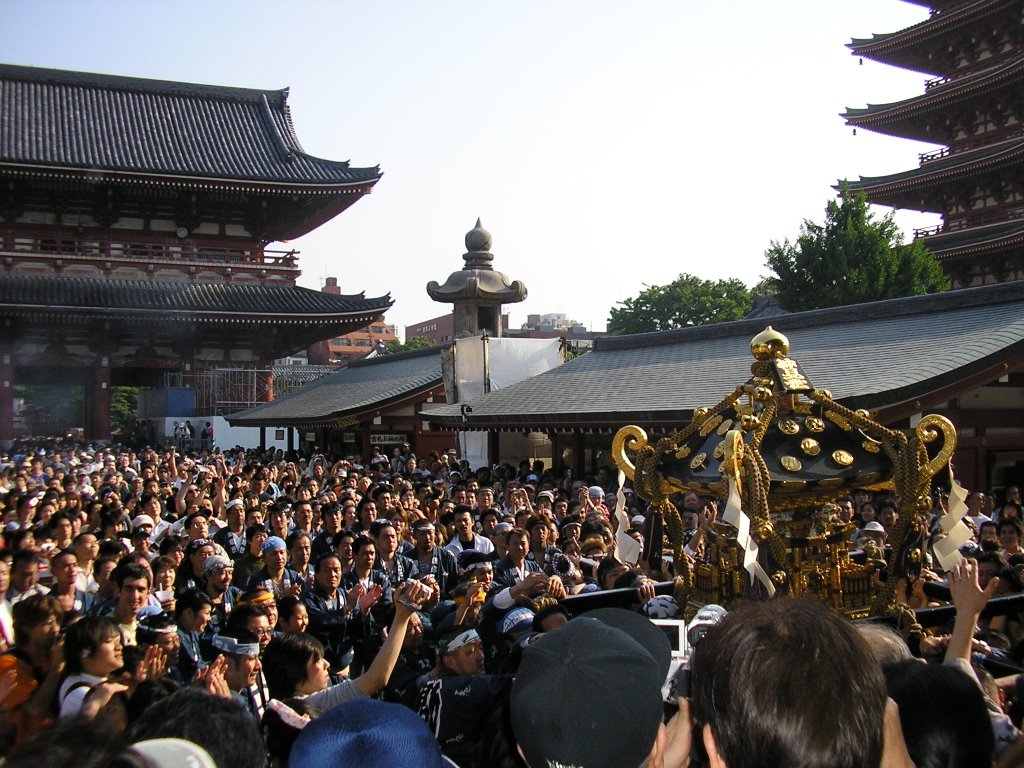
...and I`m aware that this post has tremendous whinge potential. As you can probably tell, I`m not happy. I`m going to miss this place. Thanks to this school, I`ve been drunk at ten in the morning, carting a bloody great portable shrine around the area in which I live. But that`s not saying anything really. Maybe all teachers feel like this once they`re separated from their charges, but these kids are amazing - charismatic, capable, friendly, hilarious...I could go on...

The good news is that Kyomachi is but a (powerful) gnats fart away from my humble abode, and running into the students whilst doing laundry or shopping is not at all uncommon.

So, from September, I`ll be getting two new schools - Miyuki, by all accounts, a wonderful place, and Minami Daishi, by all accounts, hell on earth. We`ll see what those bring later...

Apologies for the bleak tone this week. Even the title, "saigo desu ne?" means "it`s the end, isn`t it?" Fatalistic, but that`s Japan.

Labels: , , , , , , , ,

Sunday, May 21, 2006

Taikusai

Last weekend was to have been a sports day extravaganza, but the elements didn't agree. This led to a long series of re-scheduling plans, ending in a mid-week sports fest and two teaching-free days for myself. Hurrah indeed.

I only saw the afternoon events, starting with Shougaibutsu, a comedy relay race, reminiscent of It's a Knockout or Takeshi's Castle. Being the resident English monkey, I was asked to start the race in English. I was accompanied by one of the teachers acting as a translator, "on your marks, get set..." being incomprehensible to the sensitive Japanese ear. I feel that my companion was a bit superfluous, as I was provided with a starting pistol, which strikes me as a pretty universal signal to run.

Anyway, the Shougaibutsu was a riot. Each runner had their own obstacle; bursting balloons by sitting on them, crawling through a net, carrying a ball with a partner (back to back), balancing a tennis ball on a paddle, finding an unspecified object in a bucket of flour (using ones face) and completeing the last leg after spinning ten times around a baseball bat. This veritable ballet unfolded to a "comedy" ska soundtrack, blaring through a sizeable speaker system & reminding me that Japan has nothing in the way of noise pollution laws.

Other notable races included the Mukade, or centipede race, where a line of five students with their ankles tied together march up to two more lines, creating the titular insect, with hilarious results. Then there was the Kibasen, the "horse war". Basically three students form a human horse, whilst another stands on their hands & shoulders, and tries to knock over their opponent (on another human horse) - it's insanely exciting, and is only made more so by the chanting, clapping and frenzied Taiko banging. A teacher that I don't have the best relationship with remarked "Igirisu ja nai, ne?" (you don't have this in England, do you?) "Made in Japan". This comment awoke my inner arse, as I silently fumed "I bet that it's from China, or Mongolia or anywhere in Asia other than Japan, you arrogant little *@#^!" (can you spot a certain beligerence in this weeks entry?) All I've been able to find out so far is that the game may have its roots in Hindu mythology...watch this space...

Maybe the most Japanese thing I saw that day was the eight-hundred metres. One girl in particular was weeping openly and limping in an unsettling fashion before she started. She spoke to her teacher, who merely patted her on the back with a hearty "Gambatte! (keep your spirits up) before plonking her onto the front line. She looked frankly terrified before she started running, and she didn't stop crying. The pistol went off, as did the students. Naturally, she lagged behind, and I watched in horror, thinking "why the hell is she running on that leg?". As the race finished, some students collapsed in tears and exhaustion. The girl I had noticed at the start finished last, but now she wasn't crying. She ran the entire race. I was in absolute awe, but slightly disturbed and confused at the same time. Was it better to have been pushed into finishing a race (through peer pressure or old fashioned authority) with a wonky leg, or to rest and not run? Chariots of Fire has never seemed so appropriate as it did then.

So anyway, this weekend, we've been graced with not one, but three festivals...

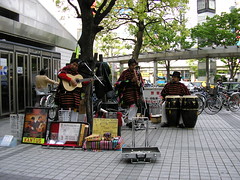
...the Design Festa


Those gentlemen were very heavy indeed.


...Oda Matsuri...


...and the legendary Sanja Matsuri...


...and I still have no idea what it's about.

Labels: , , , , , , ,

Saturday, April 29, 2006

The English Engine

Nobody could accuse the Japanese of not being thorough. Many are the fables that describe the rigorous discipline of Samurai who, it's said, would practice drawing their sword in the correct manner for an entire year before learning how to actually use it.
This meticulous (and sometimes infuriating) attitude is evident in language education, which centres around choral drilling, or constant repetition of set words and phrases.
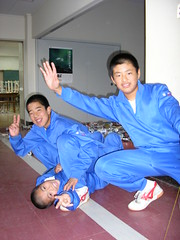
One upshot of this is that most English students here have an incredible vocabulary, but not necessarily the skills, confidence or opportunity to use it in natural conversation. Those who do, tend to have a repertoire of McSpeech - words like "really?" or phrases such as "how about you?", harmless in of themselves, but dropped in regularly to establish a casual mood, seem over-rehearsed and at worst, insincere.

That said, sounding natural in a tongue so different from your own is no mean feat. The Japanese language itself is made up of particles that set the tone of conversation, respectful language for your superiors, casual for your peers or subordinates. Even with my shaky grasp, I can see that it's an incredibly formulaic language, some "conversations" being nothing more than a repeated ritual. Erik, another ALT, has pointed out that during interviews for places at University, where, grades aside, personality would be the deciding factor, in Japan it's down to how well the applicant has memorised the procedure/ritual for presenting themselves. Perhaps all these factors, combined with the Japanese approach to tasks, is what creates the daunting mechanics of the English lesson.

This week, I've been working with the very model of a Japanese teacher. The man is a machine, probably fulfilling the dream of a chap that Matt & I met in Shinjuku, whose parting words to us were
"I want to be a walking dictionary."
For the sake of tact (and because I like him) this teacher will remain nameless. When I first met him, he impressed me with his detailed teaching plans, the pace with which they were executed and his quietly intense, but approachable classroom presence. Now he scares me a little bit. He's the quintessential Japanese workaholic, the product of a near automated education system. He looks like a well preserved forty-something. He is in fact my age.
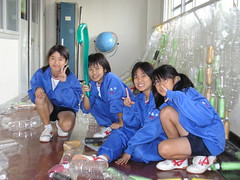
In Pictures from the Water Trade, John David Morley's character decides to leave Japan, when after inadvertently bowing to someone on the phone, he feels that he is losing touch with himself. Whilst I'm a long way off doing that, I had such a moment in this teachers class last week.

On bad days, my job is that of a human tape recorder. The prescribed, correct way of speaking English requires a rising intonation at the end of a question, exaggerated in class in order to get this (not totally alien) point across. The problem is, a solid year of repeating pretty much the same questions has resulted in my delivering them like a command, in an attempt to actually get a response from the students. My rising intonation is imperceptible sometimes, thus when I'm demonstrating how to ask a question for the new first years, I find I can't do it, and concentrating only makes it worse or weird. Funny that the wonky cog in the English Engine should be the resident native speaker.

Labels: , , , , , ,

Sunday, February 19, 2006

The Japanese and associated vexations

Differences in culture and means of approaching problems can be frustrating to both native and alien peoples.

Take for example, one of my Japanese teaching colleagues. I like the man, I admire his drive, his intelligence and his bottomless affability. Typically Japanese in those senses, also in the way he expresses dissatisfaction. I suggest something for an upcoming lesson...there is a pause...he eventually says "OK". His features betray nothing of the titanic struggle raging within, only his manner reveals every scrap of him disagreeing. Simply saying "I think not" isn't the Japanese way. He will eventually approach me later with some source to gently state what he's thinking.

Indirectness is an infuriatingly Japanese quirk. If you're asking for anything in a shop, you can be assured that unless your request is greeted with a hearty "Hai!", you know they can't help you...but they don't like saying "no" as a rule. Even though they know that their little search is going to be ultimately futile, they're still going to rush off somewhere, at least with the pretence that they're looking for whatever your request was...I rarely ask for anything in shops now.

Yes, a diatribe...bluntly put, the Japanese annoy the hell out of me on some days. Their indirectness, the racism, the rudeness, their sense of cultural mystique, their utilitarian approach to things and people...on bad days, it's easy to feel like an English speaking object. People will momentarily abduct you in the street to practice their language skills on you. At work, there are times when I'm wheeled in as the human tape recorder, the gaijin pet, the zookeeper entertaining the monkeys.

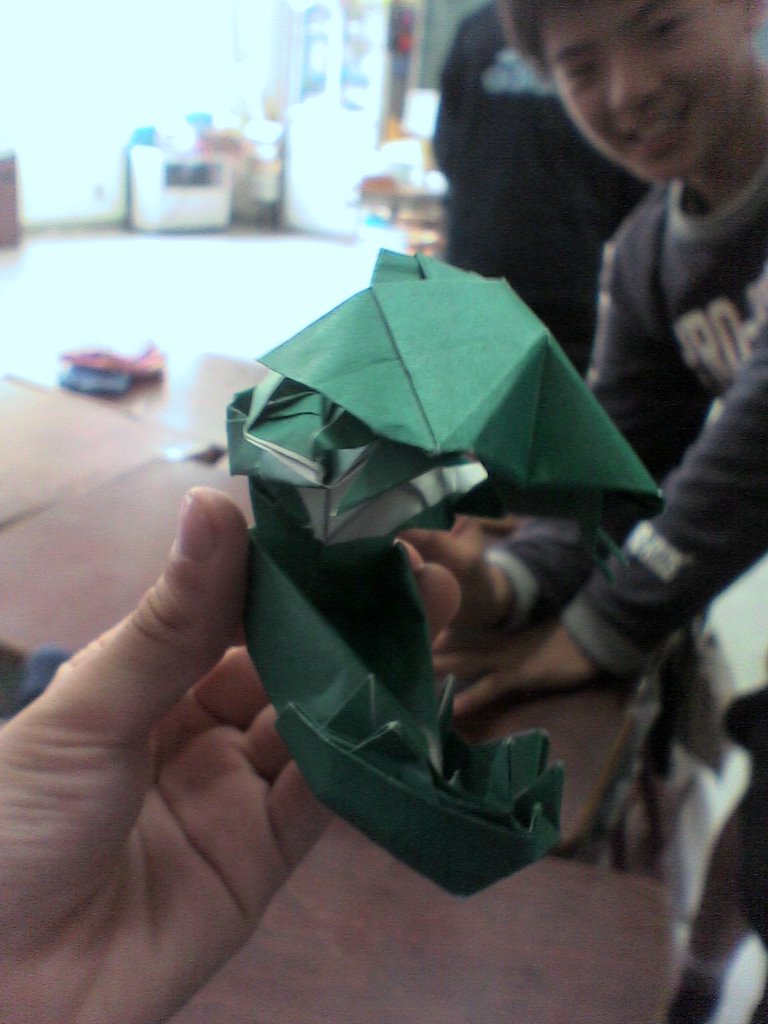
As is life, it's at these low moments that something happens to slap you around and make you retract your vitriol. The Japanese are capable of the most incredible acts of kindness. Caught short in rainstorms, I have received two umbrellas from strangers in the street. Students have made me origami dinosaur heads, presented me with a charm for my mobile phone. Our landlord consistently feeds us exotic things, and my private student has been known to present us with random high quality foodstuffs. Then, last week, whilst at the Board of Education, I bumped into a former Principal who seemed very keen to make friends with me, despite his English being about as good as my Japanese. I got the impression that he wanted to show me some photos that he had taken whilst working at a Japanese school in Mexico, which he said he'd bring in the next day. So, the day came, and he presented me, not with a photo album, but a book of really amazing photos that he had published. The key word there is "presented". Not only did he give me a truly lovely book, but he signed it in kanji, wrote another variation of my name in kanji, and gave me a mock certificate to say "congratulations, you've been here for almost a year", all written with a brush, giving the characters a wonderfully raw appearance. To cap it all off, I've been invited to his house in the Spring break, where I imagine he's going to teach me a thing or two about sake. One feels quite overwhelmed.

Labels: , , , , , ,

Friday, February 03, 2006

Setsubun

Light of a firefly, snow on windows
Many years of reading, we passed
We found now our years of school finished
This morning, we have to say good-bye

source

Poignant time of year this - the third graders have finished their entry exams, many now knowing which High School they'll be going to, some still aren't so sure. The past few days have seen a few haughty swaggers into the teachers room, and some shattered slouches.

But exam results aren't half of the trauma of leaving school. As I've mentioned before, the Japanese word for friend, tomodachi, has some deep implications. The Elementary and Junior High schools you go to are determined by the area you live in. This means that unless your family has moved at some point in your school life, you are going to have the same classmates for ten years, and you will do pretty much everything with them. Now people who've known each other for almost their entire life go in separate directions. Maybe I'm being soppy...perhaps teaching isn't the career for me if I'm faced with nostalgia every year.

Anyway, loosely connected, tomorrow is the first day of spring, today being the titular Setsubun. On this day when the new season begins, a ceremony called Mamemaki is performed, where toasted soy beans are tossed in and out of houses to the cry of

Fuku wa uchi
Oni wa soto


meaning "good luck in, bad luck (Oni, demons) out". Of the beans one tosses indoors (representing good luck) the number corresponding to your years must be eaten to assure good luck. The beans are toasted in order to kill any demons within. There are apparently many stories that describe the origin of this ritual, all of them ending with an Oni being chased out of a persons house by having beans thrown at them.

I was invited by some first graders observing the custom to their home-room during lunch, and provided with a little origami box of beans to fling out of the window - supremely good fun it was too, although I was concentrating so much on my pronunciation that I very nearly threw the good luck beans out & the bad ones in...oopsy...

One could write endlessly about the apparent contradictions in Japanese society, famed for their super-refined technology, yet carrying out a magical-religious ritual hundreds of years old...I suppose when you think about it, that sort of thing is common in the West (ie, Holy Communion, although Christians may dispute my use of the term "magical"). I think what differentiates the two rituals is attitude towards belief and approach towards ceremony. As their teacher said, she isn't religious, but she observes the custom because it's fun.

That's an outlook on religion I've seen many times since coming here, one I find incredibly interesting. Religion in Japan is an almost shapeless mass of tradition; no Canon, no Scriptures, no attempts to win converts or save the damned - just a recognition of continuity between all things and the need to co-exist in harmony...I'm quite excited by what I've read about Shinto, possibly the very core of what makes them so...well, Japanese...but I'm saving that for another entry...so I'll leave you with an enigmatic ellipsis...

Labels: , , , , , ,

Monday, January 30, 2006

Some observations...

I spent the whole of last week at one school, outside of which, road-works were taking place. They were just starting when I arrived at 8:15...by the time I left at 17:15, not only had they finished, the workmen had tarmacked over the hole they left. I walked home amazed at the Japanese work ethic, and less so at the speed with which the nation industrialised. The next day however, I came to work to find that they'd ripped up that particular bit of tarmac in order to do more work...at the end of that day, they tarmacked over the hole again...and again the next day...mid afternoon breaks to the vending machine granted me the sight of workmen using the very latest in road gnashing technology, whilst their colleague sweeps up the detritus with a witches broom. Japan was nicely summed up in that dance of diggers - dilligence, extravagant use of resources and the very new co-existing with the very old.

Keeping with this idea of a polarisation of Japanese culture (and I can't believe I've only ever alluded to this) is the fact that the Japanese can either be polite to a fault or the rudest people on the planet. This is probably down to the fundamentally Japanese concepts of uchi (inside) and soto (outside). I'll go into more detail in another entry, but put simply, the Japanese will have several uchi groups (the home, job, social club etc) and if you are outside of that group (soto) you may as well not exist...this idea was demonstrated fiercely on sunday, the Chinese New Year (of the Dog) in Yokohama (pictured).

So many people, all jostling for a space to take photos, so few prepared to test their patience...even my chivalric "ladies first" attitude towards the elderly was met with a wrinkly elbow to the groin, although that could have been something to do with the womans' size...and the hundreds of other people scrambling for a good spot.

I've almost been feeling belligerent towards the Japanese recently, maybe due to the onset of a secondary culture shock, but it's not all bad. Today I've been teaching at an elementary school that is the first in Kawasaki to call in volunteers from the local community to help with lessons. As it's a school very close to where I live, I now know a few more of my neighbours, which is very nice as I teach their children - feels like I'm becoming a sort of member of an uchi...that aside, this school is a lot of fun. Each grade is taught en masse in the gym, sometimes with costumes. There I'm wearing part of the attire of the popular TV comedy character Hard Gay. As it's elementary school, English skills are limited, but I've become friends with three fifth grade boys who've made me a member of the Penguin Club, whatever that entails...

So, in closing, I heard a Japanese childrens song courtesy of Matt the ALT the other week, and it's been bringing me almost endless delight since then...it's about a white goat who writes a letter to his friend the black goat.

Unfortunately the black goat eats the letter when he receives it. Later, the black goat wonders what was in the letter he ate, so he writes one to the white goat, asking him.

Unfortunately the white goat eats the letter when he receives it. Later, the white goat wonders what was in the letter he ate, so he writes one to the black goat asking him.

Unfortunately the black goat eats the letter when he receives it. Later, the black goat wonders what was in the letter he ate, so he writes one to the white goat asking him.

Unfortunately the white goat eats the letter when he receives it. Later, the white goat wonders what was in the letter he ate, so he writes one to the black goat asking him.

Unfortunately the black goat eats the letter when he receives it. Later, the black goat wonders what was in the letter he ate...

Labels: , , , , , , , ,

Tuesday, January 17, 2006

Salvation has big feet

Apologies if I'm repeating myself...

I am contractually obliged to be at school from 8:30 until 17:15, unless somebody tells me to go home. This is regardless of any work I may or may not have.

I can only guess (maybe accurately) on the motives of my illustrious employers' and say that they're pandering to the Japanese group/work ethic, thus leaving the decision as to what I do with my day in the hands of their clients, ie; whichever school I'm at.

The 1st graders are on a skiing trip with the Vice Principal. The 2nd graders are engaged in work experience. The 3rd graders are going through the process of applying for High Schools.

On a day like today, when I have had no classes, but still have had to be present between those hours, I'm not sure of their motives for keeping me there. In my not inconsiderable down time, I've boiled it down to three possibilities

i) They are in fact too busy to notice that I'm not actually needed today
ii) They assume that I, like them, want to save face within the working group by leaving work as late as I possibly can
iii) They are so obsessed with procedure, formality and hierarchy that even the absence of the Principal and Vice Principal isn't enough to release me when I have nothing to do, namely because neither of them are present to give their consent.

The latter seems to be the case. I only left when I did due to the intervention of Nakanishi sensei (THANK YOU) of Ojima Elementary school. Every year, teachers are given various gifts such as jackets, tracksuits and the like, and he wanted to give me a surplus pair of shoes. For convenience, he wanted me to pick them up tonight, so I was released. He had noted on my previous visit to that school that my current pair of indoor shoes (not even a year old) were tatty and maybe in need of replacing, thus beautifully demonstrating a typically Shintoist spirit of renewal and purification, and maybe shedding an unflattering light on their attitudes towards economy and ecology...rest assured, entries on those subjects will arise.

As for the shoes, they fit, they are comfortable and utterly hideous. Behold.


But no matter, they took an hour and twenty five minutes off a very long day.

On the plus, I've had plenty of free time (wherein I still get paid) to study Japanese & read about the entry on religion I've got planned (about a month in the making now) and a call for the Japanese to stop working so damn hard has been made. I'll be doing more of the same tomorrow, but unfortunately, I won't have a random shoe acquisition to save me. I may bring a chess board into school, but that would ultimately be self defeating.

Labels: , , , , ,

Saturday, October 29, 2005

Children

Disclaimer - the author accepts no responsibility for his sounding like an old git.

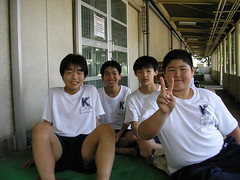
Oshima students

For years I vowed I would never become a teacher. Children were a nuisance; a noisy, irritating necessity for the preservation of the human race. I`ve changed my mind since actually working with them. I now find them rewarding and not nearly as annoying as I once did. This could be because I can`t understand about 90% of what they`re saying...time will tell on that one.

It`s obvious when you put it into words, but childhood is an interesting and tumultuous period. The speed at which you change from a child into an adult is immense, and I never appreciated it whilst I was going through it.

Oshima students

Aren`t they cute? Who would have thought that these cheerful, energetic, up-for-anything fellows would turn into sullen, smelly, work-shy teenagers? The change during Elementary School is insidiously subtle, starting to take shape in the final year...suddenly some cute kids are noticeably bigger than the ones with further to go. Whilst playing what amounted to a game of tig with thirty Elementary Sixth graders, I sustained probably my first work related injury (a wonky finger). I played the same game with eighty (yes, 80 of the little bastards)First Graders, and walked away without so much as a scratch...although that day I learned the true meaning of "sweaty".

Shincho students

By the time they get to Junior High, the change accelerates alarmingly. When the First Grade started, they were a dazzling wall of bright eyes, bushy tails, yelling "onegaishimasu!" at the start of each lesson, with all the enthusiasm I had in the face of the excitement and slight fear of big school. Of course, as the year goes on, the hormones kick in, they learn from the older students and puberty begins in earnest. Dilligence wanes, certain bits of the body become immensely fascinating, the students become gobby and their mischief takes on a more calculating form. Only the other day I was presented with a plastic bowl of some green substance (complete with floating flower) that a pack of cackling girls assured me was Green Tea. Suspicion wasn`t even warranted. I politely declined the offer, suggesting they drink it instead.

Kyomachi sports day

When Sato sensei, the man solely responsible for ALT`s in Kawasaki, said that "Japanese children have no respect", I was reminded of Kitano `Beat` Takeshi`s character in Battle Royale, but he has a point. Maybe it`s a universal phenomenon. It`s particularly evident during the Second Grade of Junior High, roughly 13-15, considered by most teachers to be the hardest year. The school I wrote about in the previous entry is by far my roughest. Last week wasn`t so bad, but I think that`s down to my not having to teach the Second Graders. To be honest, I first visited that school before summer, and having abruptly left my comfortable, safe and familiar life in Bristol to find myself on the other side of the planet, illiterate in a strange country, flung straight into a job I still wasn`t sure about...I think I needed a holiday. Many students who, at that time, horrified me, I now just see as harmless, but cheekier than most. Some students still worry me, especially those who are almost nonchalant in their aggressive rejection of everything on offer

the kids are alright

Places like that make me wonder what makes a bad school, especially when ten minutes up the road there`s a really good school. There are probably all sorts of factors; funding, staff and I suppose once serious discipline problems take hold, it`s only a matter of time before the other students follow suit. I`ve actually spoken to some teachers at that school, and they`ve gradually revelead that the problem can be traced to one man; the head of the Second Grade. His manner of dealing with the students is apparently disciplinarian to say the least. It`s difficult to get details across when language and professional tact & courtesy are issues, but it seems that the students feel ill-treated, confused and angry with his methods...hence, in part, the mass rebellion against all other authority figures. The thing is, this man has no contact with the students, unless it`s in the classroom, or the corridor, administering a wagging finger. It`s the Home Room Teachers, in many ways more responsible for the students than the parents, who are left to pick up the pieces. I`ve actually got it comparatively lucky with that school - Ueno san has told me a story about an ALT who got beaten up by three Second Graders because he told them off for eating in class.

...but these guys are friendly...

By the time they hit the Third Grade, the hormones have calmed down somewhat. They`re starting to form real opinions and becoming more rounded characters. With regards to my subject, by this point their English is pretty good, and they still have a childish sense of humour. My favorite students are the really cheeky boys who can string sentences together, usually obscene, with a degree of confidence. One memorable character constantly introduces his friend as "Mr Masturbation". Troublesome students can`t be bothered to be that disruptive - they`d rather play truant, which is fine by me.

In May, I was giving speaking tests to an entire grade - I mentioned this in the entry for that week, but doing something that repetitive really brings out the characters. One boy in particular stood out. He sat down in front of me, plonked down his score sheet and didn`t say a word. I fired question after question at him, being greeted with stony silence, as he clearly saw no point in learning English, and resented being taught it. Finally I asked him if he could speak English, and he said "No", so I gave him a point. This prompted him to say "No" even more, in protest, whilst he gestured that I remove that point from the score sheet. Even though he was making my job difficult, I admired his defiant stance, as it was so decisive and not remotely malicious. I wonder where he`s going.

Labels: , , , , ,

Sunday, October 23, 2005

A whinge...?

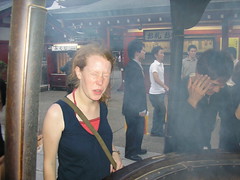
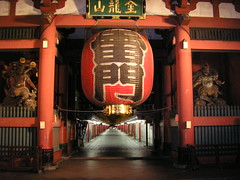
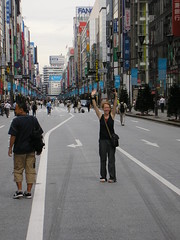
Just before I begin, here`s a few photos from a recent day-trip to Tokyo, relevant for the Sensoji stuff which I neglected to include in the last entry...

smoke gets in your eyes

Sensoji

Ginger in Ginza

Watashi desu

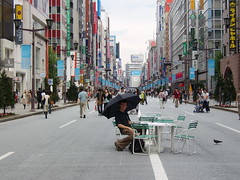
The last two are from Ginza, which was apparently one of the first places in Tokyo to Westernise...it makes sense, as this was done off the back of Emperor Meiji (1868-1912) and the Imperial Palace is only up the road. The Meiji period ended the 264 year Edo period, wherein Japan closed its borders to the rest of the world and let its indigenous culture foment. Born of the Komei family, the new fifteen year old Emperor took the title Meiji, meaning "enlightened rule" and embraced Western culture throughout his reign, sometimes called the "Meiji Restoration"(I still find it slightly strange to read Japanese writers talking about "Western Enlightenment"). The Japanese middle classes of that time are satirised in Natsume Soseki`s "I am a Cat", the protagonist observing their foibles with cool feline detachment.

But anyway...

I`ve mentioned the Japanese work ethic before, and touched on the very strong possibility that the long hours put in are a way of keeping face with the group. To leave work early can be embarassing. Not surprising then, that my illustrious employers, being a Japanese/American company are aware of this cultural quirk. Since they are a business first, rather than an educational institution, they wish to groom their product (me) to fit the expectations of their customers (the dilligent teachers), which tends to leave me, once the lessons are over, sitting on my Great British backside, invariably twiddling my thumbs, waiting for 17:15, or to be told I can go home. I don`t intend this blog to be a pedestal from which to complain, but this entry was conceived whilst I was doing just that.

The thing is, once in a Blue Moon, a teacher will say to me "There are no more classes today Chris. You can go home." The other thing is that after 14:30 EVERY DAY, there are no classes. Some days are more special than others, it would seem...

Now JET ALT`s on the other hand appear to have it very sweet. JET is a joint program between the Japanese government and sundry counterparts in the "West" (although Australia is included). They do the same job as me, but the application process is a bit tougher, lasting about a year. From where I`m sitting (my gradually numbing arse) the benefits sound rather tasty, ie, an extra ¥40,000-50,000 (200 quid) a month, and the ability to go home early if you have nothing to do.

Grrr!

But I`m not really whinging - I have benefits, in that I have to involve myself in school life, which is pretty rewarding. As a result of many an afternoon with nowt to do, I`ve been participating in the after school Brass Band, when their schedule matches mine (ie, when they don`t start at five pm). Anybody who`s played in one of these before will know what I mean when I say "pompous-wanky-military-band- arrangement" (let`s call it a "PWAMBA"). In one of the bands, we`re playing a PWAMBA of "Can`t take my eyes off you", with a highly skilled drummer, who can`t read music and loves rock, so the beat is rather Satanic and my ears are delighted.

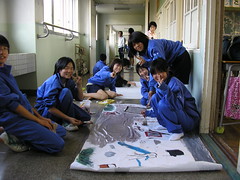
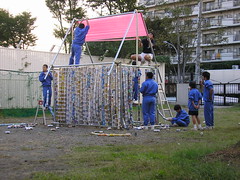
This week, the school across the road from me has been preparing for its annual culture festival, so that gave me something else to do in my not inconsiderable down-time.

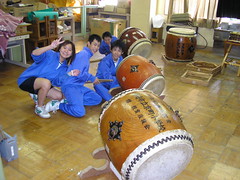
Taiko drums

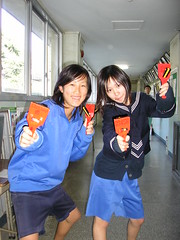
um...clicky castanet things

busy doin` nothin`...

workin` the whole day through...

tryin` to find lots of things not to do

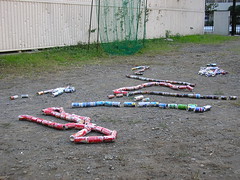
bottles...

...and cans...

...and just clap your hands, and just clap your hands...

Murakami Sensei`s class was performing a traditional Kawasaki dance, fused with healthy doses of Hip-Hop...being teenagers, not all of them were prepared to do it, and some got rather nowty about the whole thing...the good news is maybe an hour or two ago, he phoned me up saying that his class had actually been selected as the best performers of the day. He wanted to thank me for the help I gave him...the "help" being participating in rehearsals for the dance...those of you who know me will be aware that I have all the grace of an epileptic hippo throwing a tantrum induced by electric shock in the middle of an earthquake. And I`m not really that flexible. I struggled enough with following instructions in Tai Chi, and that was in English...

...this week at school surprised me...more on that in the next entry, the ominously titled "Children".

Labels: , , , , , , , ,

Thursday, September 29, 2005

Cultural misconceptions, the Japanese work ethic & other sweeping generalisations

I`ve touched on these issues in other entries...never resolved the first one; how gaijin may (or may not) be viewed by the Japanese in terms of the latters` fabled otherness. Part of the root, for teenagers at least, could be their English language textbooks, as these are probably their only reference to the English speaking world, apart from Hollywood or Fawlty Towers at a push. All the schools in Kawasaki use the same textbooks. In one of the first lessons, they learn that the English character, Ms. Jones (notable for her blonde hair and blue eyes), doesn`t like octopus. So, by the time they reach the second grade, most of the teenagers of Kawasaki have learned “I don`t like...” in the context of a westerner emphatically disliking octopus, complete with remorseful expression & “no-way-on-Gods`-earth-will-I-eat-that” hand gestures. That I find octopus even remotely palatable seems to shock many a Japanese person, none more so than the students.

Who can blame them for making this assumption? If it were solely up to Tricolore 3, I`d think that all French Bakers were terminally horny to the point of cellular collapse if their lusts went un-sated.

This phenomenon can work the other way. As well as giving peculiar impressions of the culture of the target language, your own society can be reflected in the same sense. Whilst looking for some activities on the Kawasaki City website, I discovered a “matching problems to solutions” card game, with such classics as “If you see a fire?” “Call 119”, “If you‘re hungry?” “Eat something“. The one that stands out for me is “If you’re tired?” “Drink some Ripobitan D”. Two questions instantly spring to mind;

a) What the hell is Ripobitan D? *
b) What`s wrong with a bit of kip?

I was presented with a delightful image of Englishness through a Japanese travel guide to London, the useful phrases section at the back having a victimised tourist chasing a mugger shouting “Robber!” That may come from a direct translation of the verb in question (Oi! isn’t taught at this level) - certainly when translated literally, Japanese verbs betray part of their national character - take “eat” - tabemasu. The conjugation goes “I won`t eat” - tabenai, “you WILL eat!” - tabe, “if I eat” - tabe ba and “let`s eat” - tabemashou. That a verb conjugation exists especially for the group is so Japanese you can smell it. The group is all important over here. Everybody does everything together - the word “tomodachi", although meaning "friend" has deeper connotations than the english word - a tomodachi is somebody you went to school with and did EVERYTHING with them, all the time. Solidarity within the group is paramount, but it can turn into one of those quirks that, to the alien, seems utterly bloody ridiculous. It's sometimes considered over here that the last person to leave work is the most hardworking & talented employee of the lot. I've walked home from a cathartic beer of a friday, past the school I live opposite to see the light in the Teachers room on after midnight. Murakami sensei, from that same school, didn't go home for THREE DAYS one week, staying in a capsule hotel in central Kawasaki...although I have heard stories of teachers staying behind playing Solitaire until eight at night, just so they wouldn't be the last to leave...

This brings me to the Japanese work ethic which, as I`m sure I`ve said before, is utterly bonkers. Whilst the lazy ALT was sunning himself during Golden Week, every teacher was at school from the crack of dawn, giving up this magnificent opportunity for some well-deserved rest, in order to run club activities. Kyomachi teachers are in school before me, and I live virtually across the road (although that`s probably a reason why). A lot of the students spend evenings and weekends in Jukus, or cram-schools, as entrance exams into the best High Schools and Universities are tough...but you’re pretty much set once you get there.

At five o`clock, in most work places you go to, there is a little chime that seems to say “Aaah, now it is five. Our days work is done. Come, let us go home, so that we might relax” (it also plays on tannoys in the street). This chime means nothing. Most teachers will still be in school a good two or three hours afterwards. There`s almost an unspoken expectation to put as much of yourself, to the detriment of everything else in your life, into your work. This spirit of self-sacrifice probably contributes greatly to the generally amiable Japanese demeanour, but you can take these things too far. A Samurai wouldn’t have thought twice about eviscerating himself and having a friend decapitate him if he felt he’d somehow messed up his job. Not that I’ve ever seen that at school. I have however, heard of a boy being hospitalised for three days by pushing himself too hard in a basketball tournament. Komada sensei, who runs the basketball club at Kyomachi (and fed me that alarming anecdote), is constantly knackered due to the massive workload he has. Our lessons are usually thrown together at the last minute. By contrast, Suzuki sensei is an unstoppable teaching machine - when team-teaching with her, Komada sensei and I are but marionettes to her omnipotent puppeteer. This has been re-confirmed for me by teachers at Nakanoshima Junior High, where she used to work (the Japanese education system having a policy of relocation if you‘ve been in one school for ten years). She`s a legend in her lifetime.

All that said, what`s the biggest problem I face when trying to teach English to teenagers? Motivation. Some things are true the world over. Here`s something else you can never escape from.

Pan Pipe Frenzy (17.99)

Never mind the Illuminatus...this is the real world-controlling conspiracy.

In other news, me ol` Uni-Mucka Dave has started his own blog, the uncompromisingly titled No Compassion Without Suffering. Not for the faint hearted.


* Ripobitan D is what you`d call a “Genki drink” (not an official title), “Genki” meaning “full of energy and vitality”. Genki drinks, to me, demonstrate the quintessentially Japanese attitude of “get up and go!...and keep going!”

Labels: , , , , ,

Thursday, May 19, 2005

Cross-cultural language education

All this week, I`ve been at Nakanoshima Junior High, a half-hour train journey out of Kawasaki. As a result, I`ve been getting up at five in the morning, staring bleakly at the clock on my laptop (still set to GMT) thinking that a session down the pub would be just about getting started...no more. I`ve finished at this particular school for the forseeable future. Apart from the absurd rising hour, this has been a fun week - I`ve been giving the kids a speaking test, which unfortunately has meant asking the same questions to about two-hundred and forty students, but things like that really bring out the characters. Here I`ve encountered the most fluently spoken english student yet. I asked a teacher if she knew what he was actually saying, and she responded with
"Not really, he uses a lot of very hard words." I`ll say. He`s learned all of his English from Hip-Hop albums (he even did a little yo-dance for me), and apparently "it`s the fucking shit, motherfucker."

Labels: , , , , , ,

Friday, May 06, 2005

Grrrrrr! Brrrrrrr!

A shorter entry than I`d hoped to leave this week, but needs must (I`m at work y`see). There`s nothing less likely to motivate students (or teachers for that matter) than three public holidays in a row & the first day back being a Friday. Insult to injury, it`s buggering cold, wet grey and miserable. Nothing more to say. Serves me right for gloating over my glut of holidays.

Labels: , , , ,