Friday, June 22, 2007

The dreams of the boy are those of the man.

I staggered out of bed this morning, grumpy, drowzy, stiff, barely articulate and fiercely reluctant to go to school. I arrived bang on eight, only to be greeted by the Principal and told that my lessons were cancelled, and my presence wasn't required. He was actually quite embarrassed that my company hadn't been contated to let me know. Naturally, I was very understanding, and not in the least bit cross. What a great start to the weekend.

Labels: , , , ,

Thursday, April 05, 2007

入学生

Their uniforms are pristine and slightly ill-fitting. Their dazzling white trainers squeak on the shiny floor of the gymnasium. They are absolutely tiny and some are clearly wary of me. It's funny that when I saw some of these students in Elementary School, they seemed too big and in need of getting into Junior High very quickly indeed. Now this has been accomplished, they still look out of place, but in a different way. I look forward to embarassing them in class.

Labels: , , ,

Tuesday, February 20, 2007

In defence of Native English Speakers in Japanese schools.

Mary Newton has recently written a rebuke of an article which appeared in the Daily Yomiuri on the 9th of February. Within, James W. Porcaro, Professor of English as a Foreign Language at Toyama University of International Studies, calls for an end to the Assistant Language Teacher (ALT) program (provided by JET and various private companies) on the grounds that it is a massive waste of money with little in the way of observable benefits.

The basis for his argument is a pessimistic criticism of Michael Auslin, a former ALT (from 1991-'92) who, as Prof. Porcaro neglects to mention, is himself a Professor at Yale. The picture Porcaro paints from Auslins remarks that he had "few responsibilities" and "a lot of fun", combined with his own opinions that the "fun and games" had by students in English class are in fact "detrimental" portrays ALT's as workshy graduates, looking for one more opportunity to slack off before they have to find jobs. Porcaro states that Auslin, and a total of 9,000 ALT's,

"...continue to demonstrate the same lack of educational value...at an annual cost of about 50 billion yen to Japan's taxpayers."

In an ideal situation, ALT's and their counterparts, the Japanese Teachers of English (JTE's) are supposed to present a "double act" in order to put an emphasis on communication, rather than learning grammar by rote, which doesn't necessarily aid conversation skills. The core of an effective English lesson with a JTE and an ALT is a good working relationship, but this isn't always possible for a variety of reasons.

For starters, I've been visiting four schools this year. No matter how good your relationship with the JTE is, it is impossible to be a consistent benefit to the students, because every other week, the ALT goes to a different school. When they return, the students and the JTE have adopted a routine that works without the ALT because they aren't there most of the time. Efforts are made to include the "guest", but usually these don't stray beyond the "human tape recorder" phenomenon.

Elaborating on the JTE/ALT relationship, very often, even with the most experienced JTE, they still make obscene errors of grammar. Some JTE's are hardly the "models of English-language" Porcaro describes. The ALT is useful because they represent an opportunity to communicate with the correct grammar. If the teacher is getting it wrong on the assumption that they're not, then they'll give this erroneous information to the students, which itself is deterimental to "cultivating Japanese with English abilities".

Prof. Porcoro dislikes the manner in which English is taught by ALT's, through the use of games,

"...as they merely reinforce the impression that learning English is not an important and serious endeavor..."

but a way needs to be found that makes the subject appealing to students. Many children don't see the point of learning an alien language spoken in countries on the other side of the planet. The serious approach apparently favoured by Prof. Porcaro could potentially be another opportunity for students to sleep in the middle of class, rather than a chance to get involved in speaking.

Prof. Porcaro suggests that the money thrown at ALT programs would be better spent on more training for JTE's, but I know few of these overworked and underpaid public servants who have time to spare. Also, on a broader level, there is the fundamental fallacy of "education for all" - the fact is that the only students who will be good at english are those who are interested in it, and no amount of penny pinching will change that.

He also complains that the prescence of ALT's,

"...marginalizes and diminishes the role of JTEs in front of their own students..."

as if the JTE's were the most important thing in the classroom. Education is not about the "professional growth and development" of the teachers; it is about educating students.

What Prof. Porcaro completely misses is the cultural benefits of ALT programs. This is a opportunity for genuine cultural exchange on both sides. As many ex-JET ALT's have said to me, the JET program is less about English language education and more about introducing Japan to the rest of the world. Professor Porcaro's proposals completely erase this benefit for both students in a relatively isolated society and foreign visitors with a lot to learn.

Labels: , , , , ,

Thursday, January 25, 2007

If you can't beat 'em...

This article has recently been a point of conversation amongst my fellow ALT's. In the midst of national conerns about bullying, student suicides and a perceived decline of standards, a government appointed panel has urged an end to the lenient approach favoured by schools in Japan.

As the situation stands, no form of punishment is acceptable in Japanese schools, whether it's detention, exclusion or physical violence, although according to ALT's who have worked in more rural areas, this isn't always the case. Stories of students having chalk thrown at them or being dragged through a corridor by the hair have reached me from forgotten sources.

There is a law in Japan, expressly forbiding students from being excluded from class, as they have a fundamental right to be educated. Of course, what looks good on paper rarely stands up to reality. If the student has made up their mind to be as disruptive as possible, then there is literally nothing the teacher can do.

Perhaps there are some who would welcome the chance to hit their students, but this could only create more problems, as some of the most troubled children are probably getting this at home. One of my more volatile students was hospitalised by his father for playing truant. This "protruding nail must be hammered" attitude is all well and good when constructing houses, but human beings are another matter. Unfortuantely, such attitudes don't recognise individual cases because of a historic denial of individuals.

Labels: , , , , , , ,

Wednesday, November 15, 2006

Everybody's sick...

A banner hanging from one of the third grade classroom windows, visible from the school gates, once read "A RAY OF HOPE" . Maybe in sympathy towards the current health of much of the staff, the banner has seen better days, now bearing the legend "A RAY OF H P".

The morning meeting is punctuated with sneezes, like a bizarre reworking of the 1812 Overture. Faces are white, eyes red. Everybody looks like two Japanese flags lying next to each other.

The pinnacle (or should that be abyss?) of our collective sickness is a certain science teacher, who currently resembles an animated corpse. The last time I was at this school, he collapsed. He isn't an elderly chap either, spending just as long on this planet as I have.

Why doesn't he go home? Would anybody hate him? Why is he here? I know why I'm here - I'm not anywhere near as sick as he is, and I don't have half as much work to do as him. I couldn't possibly take a day off...

...and suddenly, part of the Japanese mentality was revealed unto mine eyes...

It may be that our valiant teacher has some form of Wonder Drug coursing through his system, which prevents him from melting into the puddle of goo he clearly feels like.

Government approved drugs are the answer to all our physical problems it would seem. On those odd occasions when I've decided I'm far too snotty to risk infecting my students (the poor little lambs), I've called in sick. In response to my declaration of having a cold, my illustrious employers have suggested I take some medicine and see a Doctor. Being British, I know as well as any Doctor, that the only cure for the common cold is sleeping in, drinking tea and not getting out of ones pyjamas.

The attitude over here seems to be that unless the ailment is life threatening, the correct approach is to block out the symptoms, so the person can continue to work. Take my infamous back complications (please, take them) - flared up again after a reckless approach to picking up toothpaste.

When I finally made it to the Doctors, I presented the history of my treatment. He knew the word "physiotherapy", but that level of treatment apparently wouldn't be necessary. What I needed was drugs and lots of them - muscle relaxants, pain killers & stomach settlers to combat any adverse reactions from the other two.

This however is merely brushing dust under a carpet - I have since run out of drugs & am in considerable pain. The problem is that encounters like this leave me deeply mistrustful of Japanese hospitals...only in March, they wanted to keep me in for tonsillitis.

I know the NHS has its' problems, but I wouldn't say no to a waiting list right now...

Labels: , , , , , , ,

Thursday, November 09, 2006

Eikaiwa...and Nihongo kaiwa?

Well, so much for updating every day. In recent months, my evenings have been chocka-block with English conversation classes.

English education is a massive industry in Japan, the diabolical Nova being but one head on a veritable Hydra of Eikaiwa Kaisha (English Conversation Companies). Although some former employees have said it isn't all that bad, I consider myself fortunate not to be attached to a company like Nova (running joke over here is that it's short for "NO VAcation"). What I have is a couple of private classes, both of which just seemed to fall into my lap.

One is about fourteen adults in Yokohama, from all walks of life. This is in something of a classroom setting, and I am completely responsible for materials, lesson plans et al. This is the sort of thing I learned to do in the CELTA. Teaching adults who actually want to learn allows me to things that I'd never dream of doing with teenagers.

Tonight, I've been at a much more informal affair at a local Elementary School. My students are all teachers at this school, and I've worked with them in my day to day job.

The set up is this - we sit around a table. We drink coffee. We eat biscuits. We gossip. I get paid.

Tonight, I did something I've been planning for ages, namely, creating a CD of the most weirdly obscure and scary Japanese music I could, and subjecting these poor women to it. They were very patient, considering the looks of genuine anguish on their faces.

If that wasn't enough, on wednesdays I have a Japanese conversation class...this has had me appearing on Kawasaki Radio, and on saturday, will take me to some education centre, where I'll be giving some sort of presentation for some reason in front of an indeterminate number of people...so, the only writing I've been doing in recent days is this speech...

...so, no daily update, and a series of excuses...tune in next time when you'll read Shining Love Pig saying...

Labels: , , , , ,

Tuesday, November 07, 2006

The Tension of Tests

The English testing system over here is idiotic.

Today, I took a class of Third Year students through the rough equivalent of a dry run of their upcoming tests...although, they do so many a year that it's hard to know how decisive this particular run will be.

The procedure involves a simple greeting and maybe a few appropriately pitched questions. Then I hand them a small piece of text that may have come from a copy of "101 Paths: A Road Map to Good Citizenship". The student then reads this special brand of Japanese English and answers some utterly facile questions about what was written within. This done, the paper is discarded to make way for a couple of completely unrelated and confusing questions, before being returned to for a "what do you think?" section. There are two given answers, a positive and a negative, implied by the text and expected of a well behaved member of society.

Naturally, the students who did well in this little ballet are those I know to be diligent and capable. However, it's not their English prowess that is being stretched. The answers came verbatum from the sheet.

What is being measured here isn't an actual communicative skill; rather, it is the ability to spot hoops and jump through them.

By contrast, not an hour earlier, I had a Second Year class, where the little tykes were preparing for roughly the same thing. Being an academic year below the aforementioned class, you'd expect Second Years to have a lower ability...but surely, what marks competence in a foreign language is having the crutches and scaffolding removed, and actually being able to communicate. I had conversations with these students - we talked about their dreams. They understood questions that, as the textbook dictates, they shouldn't be able to answer.

Maybe the difference in each lesson lies in teaching method...

Labels: , , , , , , ,

Friday, June 30, 2006

最期ですね。


When I first arrived at Kyomachi Junior High, I had only been in Japan for ten days. Needless to say, with it also being my first day in a teaching job, I was utterly terrified.

Since then, I`ve been to several schools, worked with many teachers and met literally thousands of students, but I`ve always had a soft spot for those at Kyomachi, my first base school.

Being, from the point of view of the school, essentially a part time teacher, I`m more susceptible to this risk than those who don`t change location every week. The Japanese education system likes to move people around. After a certain tenure at one school, teachers may be given orders to transfer to another. Yesterday saw a shake-up in the schedules of the Kawasaki ALTs. I`ve lost Kyomachi, and my other favorite, Kawaski Junior High.

...and I`m aware that this post has tremendous whinge potential. As you can probably tell, I`m not happy. I`m going to miss this place. Thanks to this school, I`ve been drunk at ten in the morning, carting a bloody great portable shrine around the area in which I live. But that`s not saying anything really. Maybe all teachers feel like this once they`re separated from their charges, but these kids are amazing - charismatic, capable, friendly, hilarious...I could go on...

The good news is that Kyomachi is but a (powerful) gnats fart away from my humble abode, and running into the students whilst doing laundry or shopping is not at all uncommon.

So, from September, I`ll be getting two new schools - Miyuki, by all accounts, a wonderful place, and Minami Daishi, by all accounts, hell on earth. We`ll see what those bring later...

Apologies for the bleak tone this week. Even the title, "saigo desu ne?" means "it`s the end, isn`t it?" Fatalistic, but that`s Japan.

Labels: , , , , , , , ,

Saturday, April 29, 2006

The English Engine

Nobody could accuse the Japanese of not being thorough. Many are the fables that describe the rigorous discipline of Samurai who, it's said, would practice drawing their sword in the correct manner for an entire year before learning how to actually use it.
This meticulous (and sometimes infuriating) attitude is evident in language education, which centres around choral drilling, or constant repetition of set words and phrases.

One upshot of this is that most English students here have an incredible vocabulary, but not necessarily the skills, confidence or opportunity to use it in natural conversation. Those who do, tend to have a repertoire of McSpeech - words like "really?" or phrases such as "how about you?", harmless in of themselves, but dropped in regularly to establish a casual mood, seem over-rehearsed and at worst, insincere.

That said, sounding natural in a tongue so different from your own is no mean feat. The Japanese language itself is made up of particles that set the tone of conversation, respectful language for your superiors, casual for your peers or subordinates. Even with my shaky grasp, I can see that it's an incredibly formulaic language, some "conversations" being nothing more than a repeated ritual. Erik, another ALT, has pointed out that during interviews for places at University, where, grades aside, personality would be the deciding factor, in Japan it's down to how well the applicant has memorised the procedure/ritual for presenting themselves. Perhaps all these factors, combined with the Japanese approach to tasks, is what creates the daunting mechanics of the English lesson.

This week, I've been working with the very model of a Japanese teacher. The man is a machine, probably fulfilling the dream of a chap that Matt & I met in Shinjuku, whose parting words to us were
"I want to be a walking dictionary."
For the sake of tact (and because I like him) this teacher will remain nameless. When I first met him, he impressed me with his detailed teaching plans, the pace with which they were executed and his quietly intense, but approachable classroom presence. Now he scares me a little bit. He's the quintessential Japanese workaholic, the product of a near automated education system. He looks like a well preserved forty-something. He is in fact my age.

In Pictures from the Water Trade, John David Morley's character decides to leave Japan, when after inadvertently bowing to someone on the phone, he feels that he is losing touch with himself. Whilst I'm a long way off doing that, I had such a moment in this teachers class last week.

On bad days, my job is that of a human tape recorder. The prescribed, correct way of speaking English requires a rising intonation at the end of a question, exaggerated in class in order to get this (not totally alien) point across. The problem is, a solid year of repeating pretty much the same questions has resulted in my delivering them like a command, in an attempt to actually get a response from the students. My rising intonation is imperceptible sometimes, thus when I'm demonstrating how to ask a question for the new first years, I find I can't do it, and concentrating only makes it worse or weird. Funny that the wonky cog in the English Engine should be the resident native speaker.

Labels: , , , , , ,

Sunday, February 26, 2006

That was the week that was...

This week has had me at an Elementary school (6-11) every day and I love it. It's completely exhausting, playing games with hundreds of excitable tinies, but they make you feel so appreciated. Almost as a postscript to my last entry, this week I've come home with two bags of origami and half a bottle of okonomiyaki sauce.

The students are curious, enthusiastic, optomistic and not beset by the hormonal bugbears that teenagers suffer. My greetings at the start of each lesson are met with a colossal barrage of radiant shouts, preferable by far to the semi-articulate grunts I receive at Junior High.

Even amongst elderly Japanese, gaijin are something of a curiosity. The great thing about meeting very young children, is that you don't have to deal with all the pre-conceptions they've gained by the time they become adults, and their spirit of discovery is still fresh. Topics such as the colour of my eyes, my height or shoe size, the simplest revelations, provoke a classroom sized exclamation of wide eyed incredulity.

One of the best parts about the job is tricking children into learning something by playing games with them. This week for example, I've been teaching directions. First I teach the vocabulary using mime and rudimentary Japanese, then we launch into a game, whereby a blindfolded student has to listen to directions from their friends in order to find a ball and bash it with a stick. Just as much fun as it sounds and incredibly noisy.

I've pondered previously on what happens to these joyous characters to turn them into the little toe-rags I spend most of my time with. One girl in particular, when I first met her, was a model student, motivated, enthusiastic, competent and a delight to work with. Recently, although still pleasant to randomly bump into, she's the very antithesis of the student she was...listen to me, old git.

Moving swiftly on, thanks to everybody who left me a birthday comment. We went out to Tokyo in pursuit of 200 yen beers (£1 roughly, proceed with caution) and a punk night, which was like being back in Hawthornes, but relentlessly good fun, ending in a whimsical with cash taxi trip back to Kawasaki, granting us (well, me, as Hayley was asleep on my knee) the sights of Tokyo at some absurd hour in the morning. The rest of the weekend has been a cosy indoor affair, complete with cake (in the shape of a giant shrimp sushi), senbei and the complete series of Black Adder...Happy Birthday to me indeed...

Labels: , , , ,

Sunday, February 19, 2006

The Japanese and associated vexations

Differences in culture and means of approaching problems can be frustrating to both native and alien peoples.

Take for example, one of my Japanese teaching colleagues. I like the man, I admire his drive, his intelligence and his bottomless affability. Typically Japanese in those senses, also in the way he expresses dissatisfaction. I suggest something for an upcoming lesson...there is a pause...he eventually says "OK". His features betray nothing of the titanic struggle raging within, only his manner reveals every scrap of him disagreeing. Simply saying "I think not" isn't the Japanese way. He will eventually approach me later with some source to gently state what he's thinking.

Indirectness is an infuriatingly Japanese quirk. If you're asking for anything in a shop, you can be assured that unless your request is greeted with a hearty "Hai!", you know they can't help you...but they don't like saying "no" as a rule. Even though they know that their little search is going to be ultimately futile, they're still going to rush off somewhere, at least with the pretence that they're looking for whatever your request was...I rarely ask for anything in shops now.

Yes, a diatribe...bluntly put, the Japanese annoy the hell out of me on some days. Their indirectness, the racism, the rudeness, their sense of cultural mystique, their utilitarian approach to things and people...on bad days, it's easy to feel like an English speaking object. People will momentarily abduct you in the street to practice their language skills on you. At work, there are times when I'm wheeled in as the human tape recorder, the gaijin pet, the zookeeper entertaining the monkeys.

As is life, it's at these low moments that something happens to slap you around and make you retract your vitriol. The Japanese are capable of the most incredible acts of kindness. Caught short in rainstorms, I have received two umbrellas from strangers in the street. Students have made me origami dinosaur heads, presented me with a charm for my mobile phone. Our landlord consistently feeds us exotic things, and my private student has been known to present us with random high quality foodstuffs. Then, last week, whilst at the Board of Education, I bumped into a former Principal who seemed very keen to make friends with me, despite his English being about as good as my Japanese. I got the impression that he wanted to show me some photos that he had taken whilst working at a Japanese school in Mexico, which he said he'd bring in the next day. So, the day came, and he presented me, not with a photo album, but a book of really amazing photos that he had published. The key word there is "presented". Not only did he give me a truly lovely book, but he signed it in kanji, wrote another variation of my name in kanji, and gave me a mock certificate to say "congratulations, you've been here for almost a year", all written with a brush, giving the characters a wonderfully raw appearance. To cap it all off, I've been invited to his house in the Spring break, where I imagine he's going to teach me a thing or two about sake. One feels quite overwhelmed.

Labels: , , , , , ,

Monday, January 30, 2006

Some observations...

I spent the whole of last week at one school, outside of which, road-works were taking place. They were just starting when I arrived at 8:15...by the time I left at 17:15, not only had they finished, the workmen had tarmacked over the hole they left. I walked home amazed at the Japanese work ethic, and less so at the speed with which the nation industrialised. The next day however, I came to work to find that they'd ripped up that particular bit of tarmac in order to do more work...at the end of that day, they tarmacked over the hole again...and again the next day...mid afternoon breaks to the vending machine granted me the sight of workmen using the very latest in road gnashing technology, whilst their colleague sweeps up the detritus with a witches broom. Japan was nicely summed up in that dance of diggers - dilligence, extravagant use of resources and the very new co-existing with the very old.

Keeping with this idea of a polarisation of Japanese culture (and I can't believe I've only ever alluded to this) is the fact that the Japanese can either be polite to a fault or the rudest people on the planet. This is probably down to the fundamentally Japanese concepts of uchi (inside) and soto (outside). I'll go into more detail in another entry, but put simply, the Japanese will have several uchi groups (the home, job, social club etc) and if you are outside of that group (soto) you may as well not exist...this idea was demonstrated fiercely on sunday, the Chinese New Year (of the Dog) in Yokohama (pictured).

So many people, all jostling for a space to take photos, so few prepared to test their patience...even my chivalric "ladies first" attitude towards the elderly was met with a wrinkly elbow to the groin, although that could have been something to do with the womans' size...and the hundreds of other people scrambling for a good spot.

I've almost been feeling belligerent towards the Japanese recently, maybe due to the onset of a secondary culture shock, but it's not all bad. Today I've been teaching at an elementary school that is the first in Kawasaki to call in volunteers from the local community to help with lessons. As it's a school very close to where I live, I now know a few more of my neighbours, which is very nice as I teach their children - feels like I'm becoming a sort of member of an uchi...that aside, this school is a lot of fun. Each grade is taught en masse in the gym, sometimes with costumes. There I'm wearing part of the attire of the popular TV comedy character Hard Gay. As it's elementary school, English skills are limited, but I've become friends with three fifth grade boys who've made me a member of the Penguin Club, whatever that entails...

So, in closing, I heard a Japanese childrens song courtesy of Matt the ALT the other week, and it's been bringing me almost endless delight since then...it's about a white goat who writes a letter to his friend the black goat.

Unfortunately the black goat eats the letter when he receives it. Later, the black goat wonders what was in the letter he ate, so he writes one to the white goat, asking him.

Unfortunately the white goat eats the letter when he receives it. Later, the white goat wonders what was in the letter he ate, so he writes one to the black goat asking him.

Unfortunately the black goat eats the letter when he receives it. Later, the black goat wonders what was in the letter he ate, so he writes one to the white goat asking him.

Unfortunately the white goat eats the letter when he receives it. Later, the white goat wonders what was in the letter he ate, so he writes one to the black goat asking him.

Unfortunately the black goat eats the letter when he receives it. Later, the black goat wonders what was in the letter he ate...

Labels: , , , , , , , ,

Saturday, October 29, 2005

Children

Disclaimer - the author accepts no responsibility for his sounding like an old git.
Oshima students

For years I vowed I would never become a teacher. Children were a nuisance; a noisy, irritating necessity for the preservation of the human race. I`ve changed my mind since actually working with them. I now find them rewarding and not nearly as annoying as I once did. This could be because I can`t understand about 90% of what they`re saying...time will tell on that one.

It`s obvious when you put it into words, but childhood is an interesting and tumultuous period. The speed at which you change from a child into an adult is immense, and I never appreciated it whilst I was going through it.

Oshima students

Aren`t they cute? Who would have thought that these cheerful, energetic, up-for-anything fellows would turn into sullen, smelly, work-shy teenagers? The change during Elementary School is insidiously subtle, starting to take shape in the final year...suddenly some cute kids are noticeably bigger than the ones with further to go. Whilst playing what amounted to a game of tig with thirty Elementary Sixth graders, I sustained probably my first work related injury (a wonky finger). I played the same game with eighty (yes, 80 of the little bastards)First Graders, and walked away without so much as a scratch...although that day I learned the true meaning of "sweaty".

Shincho students

By the time they get to Junior High, the change accelerates alarmingly. When the First Grade started, they were a dazzling wall of bright eyes, bushy tails, yelling "onegaishimasu!" at the start of each lesson, with all the enthusiasm I had in the face of the excitement and slight fear of big school. Of course, as the year goes on, the hormones kick in, they learn from the older students and puberty begins in earnest. Dilligence wanes, certain bits of the body become immensely fascinating, the students become gobby and their mischief takes on a more calculating form. Only the other day I was presented with a plastic bowl of some green substance (complete with floating flower) that a pack of cackling girls assured me was Green Tea. Suspicion wasn`t even warranted. I politely declined the offer, suggesting they drink it instead.
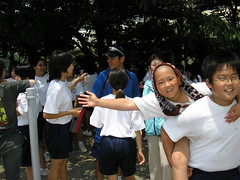
Kyomachi sports day

When Sato sensei, the man solely responsible for ALT`s in Kawasaki, said that "Japanese children have no respect", I was reminded of Kitano `Beat` Takeshi`s character in Battle Royale, but he has a point. Maybe it`s a universal phenomenon. It`s particularly evident during the Second Grade of Junior High, roughly 13-15, considered by most teachers to be the hardest year. The school I wrote about in the previous entry is by far my roughest. Last week wasn`t so bad, but I think that`s down to my not having to teach the Second Graders. To be honest, I first visited that school before summer, and having abruptly left my comfortable, safe and familiar life in Bristol to find myself on the other side of the planet, illiterate in a strange country, flung straight into a job I still wasn`t sure about...I think I needed a holiday. Many students who, at that time, horrified me, I now just see as harmless, but cheekier than most. Some students still worry me, especially those who are almost nonchalant in their aggressive rejection of everything on offer
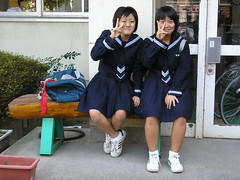
the kids are alright

Places like that make me wonder what makes a bad school, especially when ten minutes up the road there`s a really good school. There are probably all sorts of factors; funding, staff and I suppose once serious discipline problems take hold, it`s only a matter of time before the other students follow suit. I`ve actually spoken to some teachers at that school, and they`ve gradually revelead that the problem can be traced to one man; the head of the Second Grade. His manner of dealing with the students is apparently disciplinarian to say the least. It`s difficult to get details across when language and professional tact & courtesy are issues, but it seems that the students feel ill-treated, confused and angry with his methods...hence, in part, the mass rebellion against all other authority figures. The thing is, this man has no contact with the students, unless it`s in the classroom, or the corridor, administering a wagging finger. It`s the Home Room Teachers, in many ways more responsible for the students than the parents, who are left to pick up the pieces. I`ve actually got it comparatively lucky with that school - Ueno san has told me a story about an ALT who got beaten up by three Second Graders because he told them off for eating in class.
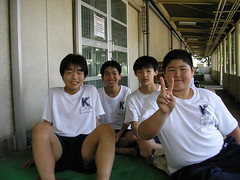
...but these guys are friendly...

By the time they hit the Third Grade, the hormones have calmed down somewhat. They`re starting to form real opinions and becoming more rounded characters. With regards to my subject, by this point their English is pretty good, and they still have a childish sense of humour. My favorite students are the really cheeky boys who can string sentences together, usually obscene, with a degree of confidence. One memorable character constantly introduces his friend as "Mr Masturbation". Troublesome students can`t be bothered to be that disruptive - they`d rather play truant, which is fine by me.

In May, I was giving speaking tests to an entire grade - I mentioned this in the entry for that week, but doing something that repetitive really brings out the characters. One boy in particular stood out. He sat down in front of me, plonked down his score sheet and didn`t say a word. I fired question after question at him, being greeted with stony silence, as he clearly saw no point in learning English, and resented being taught it. Finally I asked him if he could speak English, and he said "No", so I gave him a point. This prompted him to say "No" even more, in protest, whilst he gestured that I remove that point from the score sheet. Even though he was making my job difficult, I admired his defiant stance, as it was so decisive and not remotely malicious. I wonder where he`s going.

Labels: , , , , ,

Thursday, September 29, 2005

Cultural misconceptions, the Japanese work ethic & other sweeping generalisations

I`ve touched on these issues in other entries...never resolved the first one; how gaijin may (or may not) be viewed by the Japanese in terms of the latters` fabled otherness. Part of the root, for teenagers at least, could be their English language textbooks, as these are probably their only reference to the English speaking world, apart from Hollywood or Fawlty Towers at a push. All the schools in Kawasaki use the same textbooks. In one of the first lessons, they learn that the English character, Ms. Jones (notable for her blonde hair and blue eyes), doesn`t like octopus. So, by the time they reach the second grade, most of the teenagers of Kawasaki have learned “I don`t like...” in the context of a westerner emphatically disliking octopus, complete with remorseful expression & “no-way-on-Gods`-earth-will-I-eat-that” hand gestures. That I find octopus even remotely palatable seems to shock many a Japanese person, none more so than the students.

Who can blame them for making this assumption? If it were solely up to Tricolore 3, I`d think that all French Bakers were terminally horny to the point of cellular collapse if their lusts went un-sated.

This phenomenon can work the other way. As well as giving peculiar impressions of the culture of the target language, your own society can be reflected in the same sense. Whilst looking for some activities on the Kawasaki City website, I discovered a “matching problems to solutions” card game, with such classics as “If you see a fire?” “Call 119”, “If you‘re hungry?” “Eat something“. The one that stands out for me is “If you’re tired?” “Drink some Ripobitan D”. Two questions instantly spring to mind;

a) What the hell is Ripobitan D? *
b) What`s wrong with a bit of kip?

I was presented with a delightful image of Englishness through a Japanese travel guide to London, the useful phrases section at the back having a victimised tourist chasing a mugger shouting “Robber!” That may come from a direct translation of the verb in question (Oi! isn’t taught at this level) - certainly when translated literally, Japanese verbs betray part of their national character - take “eat” - tabemasu. The conjugation goes “I won`t eat” - tabenai, “you WILL eat!” - tabe, “if I eat” - tabe ba and “let`s eat” - tabemashou. That a verb conjugation exists especially for the group is so Japanese you can smell it. The group is all important over here. Everybody does everything together - the word “tomodachi", although meaning "friend" has deeper connotations than the english word - a tomodachi is somebody you went to school with and did EVERYTHING with them, all the time. Solidarity within the group is paramount, but it can turn into one of those quirks that, to the alien, seems utterly bloody ridiculous. It's sometimes considered over here that the last person to leave work is the most hardworking & talented employee of the lot. I've walked home from a cathartic beer of a friday, past the school I live opposite to see the light in the Teachers room on after midnight. Murakami sensei, from that same school, didn't go home for THREE DAYS one week, staying in a capsule hotel in central Kawasaki...although I have heard stories of teachers staying behind playing Solitaire until eight at night, just so they wouldn't be the last to leave...

This brings me to the Japanese work ethic which, as I`m sure I`ve said before, is utterly bonkers. Whilst the lazy ALT was sunning himself during Golden Week, every teacher was at school from the crack of dawn, giving up this magnificent opportunity for some well-deserved rest, in order to run club activities. Kyomachi teachers are in school before me, and I live virtually across the road (although that`s probably a reason why). A lot of the students spend evenings and weekends in Jukus, or cram-schools, as entrance exams into the best High Schools and Universities are tough...but you’re pretty much set once you get there.

At five o`clock, in most work places you go to, there is a little chime that seems to say “Aaah, now it is five. Our days work is done. Come, let us go home, so that we might relax” (it also plays on tannoys in the street). This chime means nothing. Most teachers will still be in school a good two or three hours afterwards. There`s almost an unspoken expectation to put as much of yourself, to the detriment of everything else in your life, into your work. This spirit of self-sacrifice probably contributes greatly to the generally amiable Japanese demeanour, but you can take these things too far. A Samurai wouldn’t have thought twice about eviscerating himself and having a friend decapitate him if he felt he’d somehow messed up his job. Not that I’ve ever seen that at school. I have however, heard of a boy being hospitalised for three days by pushing himself too hard in a basketball tournament. Komada sensei, who runs the basketball club at Kyomachi (and fed me that alarming anecdote), is constantly knackered due to the massive workload he has. Our lessons are usually thrown together at the last minute. By contrast, Suzuki sensei is an unstoppable teaching machine - when team-teaching with her, Komada sensei and I are but marionettes to her omnipotent puppeteer. This has been re-confirmed for me by teachers at Nakanoshima Junior High, where she used to work (the Japanese education system having a policy of relocation if you‘ve been in one school for ten years). She`s a legend in her lifetime.

All that said, what`s the biggest problem I face when trying to teach English to teenagers? Motivation. Some things are true the world over. Here`s something else you can never escape from.

Pan Pipe Frenzy (17.99)

Never mind the Illuminatus...this is the real world-controlling conspiracy.

In other news, me ol` Uni-Mucka Dave has started his own blog, the uncompromisingly titled No Compassion Without Suffering. Not for the faint hearted.


* Ripobitan D is what you`d call a “Genki drink” (not an official title), “Genki” meaning “full of energy and vitality”. Genki drinks, to me, demonstrate the quintessentially Japanese attitude of “get up and go!...and keep going!”

Labels: , , , , ,

Thursday, June 23, 2005

The names have been omitted to protect the partially responsible (and to cover my arse)

Every teenager in Japan can ask “How are you” and answer “I`m fine thankyou, and you?” Except those at this one school...the funny thing is, when I was there two months ago, they could. They could even say they liked something other than baseball. The first class that meets my impossibly cheerful “Good morning, how are you?” with row upon row of befuddled faces could almost be let slide (it was Monday after all). The second is a bit more serious. The third makes me wonder what the Japanese English teachers have been doing for the past two months.

This was going to be a passionately vitriolic entry about bad teachers and my horror that they`re placed in charge of young minds...since its inception, I`ve climbed down from my high horse somewhat, particularly after fulfilling my burning desire to take the reins from a certain unnamed teacher, and finding myself faced with a mob of sulky unmotivated teenagers. Experiencing just how difficult it can be, I suddenly felt slightly bad about the venom with which I`ve described him in the past, but he`s still a crap teacher. The same sulky teenagers are putty in the hands of another teacher at that school.

With my sails bereft of the winds of fury, my pontificating deflates like a farting balloon...I worked out a few weeks ago that if a teacher "fails" a student, then they have also quite literally failed as a teacher, but the teachers aren`t completely responsible, and you can`t blame society`s ills on children. It`s all too bleak, I`ve only been an assistant language teacher for two months, this is a rough school and I don`t want to preach...if you fancy a laugh after this malignant dwarf of an entry, then these suicidal rabbits (taken from my mate Ben`s website, but he nicked it from somebody else) should raise a black chuckle or two.

Labels: , , , ,

Thursday, May 19, 2005

Cross-cultural language education

All this week, I`ve been at Nakanoshima Junior High, a half-hour train journey out of Kawasaki. As a result, I`ve been getting up at five in the morning, staring bleakly at the clock on my laptop (still set to GMT) thinking that a session down the pub would be just about getting started...no more. I`ve finished at this particular school for the forseeable future. Apart from the absurd rising hour, this has been a fun week - I`ve been giving the kids a speaking test, which unfortunately has meant asking the same questions to about two-hundred and forty students, but things like that really bring out the characters. Here I`ve encountered the most fluently spoken english student yet. I asked a teacher if she knew what he was actually saying, and she responded with
"Not really, he uses a lot of very hard words." I`ll say. He`s learned all of his English from Hip-Hop albums (he even did a little yo-dance for me), and apparently "it`s the fucking shit, motherfucker."

Labels: , , , , , ,

Friday, May 06, 2005

Grrrrrr! Brrrrrrr!

A shorter entry than I`d hoped to leave this week, but needs must (I`m at work y`see). There`s nothing less likely to motivate students (or teachers for that matter) than three public holidays in a row & the first day back being a Friday. Insult to injury, it`s buggering cold, wet grey and miserable. Nothing more to say. Serves me right for gloating over my glut of holidays.

Labels: , , , ,

Thursday, April 14, 2005

ONEGAISHIMASU!!

Sports day at Kyomachi school today, so I spent the entire day preparing a game of snap that involves regular & irregular verbs in the past & present tense for one of my 2nd grade classes. After nearly paralysing myself with over-indulgence of scissors & general chopstick fatigue, I discovered the electric guillotine at 16:45...I need to be wary of what I say in unguarded moments, lest I inadvertantly create a selection of Japanese teenagers who speak English just like me (heavens to murgatroyd). My main english teacher, Komada sensei (an all-round good egg) now thinks that the correct English for an electric guillotine is "a cutting device".

One of the kids in this particular class (2C) lives somewhere near me & clocked me whilst I was buying some food. Now he`s (one of) my new best mates - I got invited to lunch with his class, as they all eat in their homeroom. Great experience - hardly said a word because their English isn`t much beyond "how do you do? my name is...", and officially, I can`t speak Japanese (in order to get them to constantly use English). TWO (yes, two) of the kids gave me a massage & it was buggering brilliant.

So many kids with bizarre names to memorise. I`m beset with Ayami`s & Shiyu`s & Katsumi`s & Koru`s...it`s not fair...they all know MY name, but there`s only one Chris (an experience in of itself) and millions of them. Actually, there`s one girl, Netsumi, who`s seemingly made it her business to ensure that I remember her name. Amongst noisy, bossy, bolshy teenagers, this girl is Leviathan.

In closing? I am currently learning Kanji A Clockwork Orange style on the trains, "substituting" mind altering drugs with coffee. Twenty & counting...only a couple of thousand to go.

Labels: , , , , ,