Thursday, July 19, 2007

You're not from round 'ere, are you?

Some months ago, I was killing time when an old woman stopped me in the street with "Oooo, you're not Japanese are you?" Comparing her with the robust physique of my septuagenarian landlord, she must have been at least eighty, with poor eyes, as she was within a foot of me when she made this disovery. I explained that I was English, and her expression was one of colossal surprise, spilling over into delight.
"Hajimete!" she exclaimed, meaning "first time," and in this context, "this is the first time I've met an Englishman." We bade each other well, and kept walking to wherever we were going. I forgot about it until today.

During the break at school today, I was chatting with the Principal, when seven or eight second year students came to have a chat. Readers who know me will be aware that I have a somewhat flexible face. To children of a culture that doesn't usually communicate with facial expressions and body language, this can be hilarious.
"Foreigners are funny." remarked a girl, mid-giggle. The Principal pointed out that, as far as I was concerned, everybody in the room was a foreigner.
"Really?!" asked the girl, genuinely surprised. Then again, she is only seven.

Labels: , , ,

Friday, June 22, 2007

The dreams of the boy are those of the man.

I staggered out of bed this morning, grumpy, drowzy, stiff, barely articulate and fiercely reluctant to go to school. I arrived bang on eight, only to be greeted by the Principal and told that my lessons were cancelled, and my presence wasn't required. He was actually quite embarrassed that my company hadn't been contated to let me know. Naturally, I was very understanding, and not in the least bit cross. What a great start to the weekend.

Labels: , , , ,

Thursday, May 17, 2007

Rapture

To my profound joy, a couple of my second year boys have hit upon the hilarious revelation that my name, with regards to the Japanese rendering of Western words, is but two syllables away from "clitoris." That they excercise their discovery with such regularity makes me hope they might actually start learning some new words...but I'm not holding my breath.

Labels: , , , ,

Saturday, May 12, 2007

Brass Band Club

Yesterday, I played my trumpet for the first time in a long time, but perhaps more significantly, the first time since I've given up smoking. Clearly my lungs have had plenty of time to recover, and I wasn't as breathless as I thought I would be. Perhaps it's time to get back into music. Finding the right outlet could be tricky though. The only one I've discovered thus far is the school Brass Band club.

Of course, five minutes into the club activity, I remembered why I never go. A word now irrevocably linked to my idea of Japanese education is drilling. Yes, all my teachers over the years have told me that it's really useful to spend ages doing long notes, and by thunder, it'll build your stamina, but where's the fun?

A typical brass band club session will commence with the designated leader announcing what particular warm-up exercise will be played. Everyone responds with "Hai!" which although means "yes" is probably closer to "affirmative". This exercise will be done for a minute or two. At this point, I'm usually raring to play some actual music, but there's more to be had. Much more. In the past, I've joined brass band club sessions where the kids have played long notes and scales for an entire hour...five minutes break...another hour of long notes and scales, thankyou very much, time to go home.

This particular brass band did something I've never seen before - at a command from the leader, every child produced a plastic bag, and started breathing into it whilst the percussion section dutifully beat out an increasing number of beats on a row of desks behind us.

The weirdest thing I've experienced thus far in brass band club is the tuning up process. There's nothing wrong with using an electronic tuner, but they seem to be speaking a foreign language (in terms of the music vocabulary I was raised with) when they hold a beeping box in front of my instrument and declare "plus four" as opposed to "sharp" or "flat."

Although music is something I want to get back into, I'm faced with the choice between intense study of Japanese (at a desk and everything) and playing long notes for two hours...what to do...

Labels: , , ,

Thursday, April 19, 2007

?!?!

Yesterday, I used the school computer to visit All Music in pursuit of information about Rainer Bruninghaus. Today I discover that this little trip has infected the computer with spyware, and I'm sort of in trouble. An apology from me isn't enough, in fact a senior teacher has to write a letter of apology to the board of education.

Flabberghasted just isn't strong enough.

Labels: , , , ,

Thursday, April 05, 2007

入学生

Their uniforms are pristine and slightly ill-fitting. Their dazzling white trainers squeak on the shiny floor of the gymnasium. They are absolutely tiny and some are clearly wary of me. It's funny that when I saw some of these students in Elementary School, they seemed too big and in need of getting into Junior High very quickly indeed. Now this has been accomplished, they still look out of place, but in a different way. I look forward to embarassing them in class.

Labels: , , ,

Friday, March 09, 2007

Another Graduation...

The year seems to have passed in the blink of an eye, but at the same time dragged like a leaden coat and tails. The proceedings were just as emotional as last year, but we were graced with no less than three teachers wearing Hakama. Pictured is Endo Sensei, a teacher of Japanese who sits next to me, and one of the special needs teachers, whose name I haven't caught yet.


As is the way with these things, everybody filed into the ostentatiously decorated gym, applauded whilst one hundred and fifty students marched slowly to their seats (by the end of two out of four classes, I was desperate to stop clapping), possibly daydreamed whilst those same students were presented with certificates, and almost certainly fell asleep during the Koucho sensei's (Principal's) speech. Notable this year was the fact that the farewell procession of sobbing third graders went out through the sports ground. By the time that had been organised, most of them had cheered up.


I signed a lot of year books, posed for an inordinate number of pictures, had a very tasty bento, complete with sekihan (rice steamed with sweet red beans) and then...nothing...

Long term readers of this blog will be aware of my most common complaint with work. For those of you who have come here by accident (and have made it this far), regardless of my workload or the actual presence of students, I'm required to stay on school grounds until 4:30. Usually I use this as an opportunity to really hammer my Japanese studies, but today (and days like it in the past) a cloudy block descended, rendering me incapable of concentration due to the sheer absurdity of it all. Why was I there? What purpose did it serve?

I sat there for a while and actually managed to get a bit of study done, but that niggling sense of being able to do it at home kept knocking. Then teachers started leaving at the morally reprehensible time of 2:30, and I began to question my sanity.

At the end of each day, I'm supposed to get a stamp on my time sheet from the Vice Principal (Kyoto Sensei). At Elementary School, where I usually finish at 1pm, I can coax permission to leave from the Kyoto by handing them my time sheet for the stamp, which invariably ellicits the salutation "O tsukare sama deshita," which literally means "honorific tired person was" and kind of means "very good day at work, you must be tired, (I'm) go(ing) home". Faced with another couple of hours of enraged thumb twiddling, I readied my paperwork for the walk up to the Kyoto's desk, only to be stopped by one Kamihara sensei, a Social Studies teacher for whom I have tremendous respect, not least of all for his affable charisma, who suggested we go to the gym and practice Kendo. Strike me down with a bamboo sword if I didn't say yes.

Kendo, simply put, involves donning cumbersome and visibility-reducing armour, before bashing your opponent with a big stick and shouting at them. There are three strike points, the head, wrist and body (or rather, right hip). Kamihara sensei is very good.

Kendo might look simple, but precision is the key. Kamihara sensei was really walloping me - I could feel it with the blows he rained down on my head - but I emerged relatively bruise free. The armour is pretty solid, and a direct hit will do little more than ring in your ears. I however have all the precision of a rabid elephant on a motorcycle, as Kamihara sensei's right hip can no doubt testify.

That done, he suggested we have a bout of Aikido which I am genuinely interested in. Quintessentially a self defense martial art, Aikido relies upon using the energy expended by potential attackers back on themselves. Kamihara sensei is also remarkably good at that, flooring me several times during our spat. I returned to the teachers room an hour later, sweaty, bruised and in the highest of spirits...

...until the Kyoto sensei (who can't speak a lick of English) asked an English teacher what I was doing today. That ruffled me a bit because I can actually speak Japanese. Said English teacher didn't ask me, rather she said she didn't know, and we should ask a different English teacher. Bear in mind that I am within spitting distance of these people. Off goes the Kyoto to find this other teacher, whilst I ask the English teacher if there was anything I could help with. She looked me in the eye and shook her head. I held my gaze, and she eventually came clean, not that there was anything to bloody well come clean about - grrr! I hate this country sometimes.

Peculiar day, highs, lows, tears, laughter, civility, lack of and bashing people with sticks. I'm going out with Hayley for her birthday.

Labels: , , , , , , , ,

Tuesday, February 20, 2007

In defence of Native English Speakers in Japanese schools.

Mary Newton has recently written a rebuke of an article which appeared in the Daily Yomiuri on the 9th of February. Within, James W. Porcaro, Professor of English as a Foreign Language at Toyama University of International Studies, calls for an end to the Assistant Language Teacher (ALT) program (provided by JET and various private companies) on the grounds that it is a massive waste of money with little in the way of observable benefits.

The basis for his argument is a pessimistic criticism of Michael Auslin, a former ALT (from 1991-'92) who, as Prof. Porcaro neglects to mention, is himself a Professor at Yale. The picture Porcaro paints from Auslins remarks that he had "few responsibilities" and "a lot of fun", combined with his own opinions that the "fun and games" had by students in English class are in fact "detrimental" portrays ALT's as workshy graduates, looking for one more opportunity to slack off before they have to find jobs. Porcaro states that Auslin, and a total of 9,000 ALT's,

"...continue to demonstrate the same lack of educational value...at an annual cost of about 50 billion yen to Japan's taxpayers."

In an ideal situation, ALT's and their counterparts, the Japanese Teachers of English (JTE's) are supposed to present a "double act" in order to put an emphasis on communication, rather than learning grammar by rote, which doesn't necessarily aid conversation skills. The core of an effective English lesson with a JTE and an ALT is a good working relationship, but this isn't always possible for a variety of reasons.

For starters, I've been visiting four schools this year. No matter how good your relationship with the JTE is, it is impossible to be a consistent benefit to the students, because every other week, the ALT goes to a different school. When they return, the students and the JTE have adopted a routine that works without the ALT because they aren't there most of the time. Efforts are made to include the "guest", but usually these don't stray beyond the "human tape recorder" phenomenon.

Elaborating on the JTE/ALT relationship, very often, even with the most experienced JTE, they still make obscene errors of grammar. Some JTE's are hardly the "models of English-language" Porcaro describes. The ALT is useful because they represent an opportunity to communicate with the correct grammar. If the teacher is getting it wrong on the assumption that they're not, then they'll give this erroneous information to the students, which itself is deterimental to "cultivating Japanese with English abilities".

Prof. Porcoro dislikes the manner in which English is taught by ALT's, through the use of games,

"...as they merely reinforce the impression that learning English is not an important and serious endeavor..."

but a way needs to be found that makes the subject appealing to students. Many children don't see the point of learning an alien language spoken in countries on the other side of the planet. The serious approach apparently favoured by Prof. Porcaro could potentially be another opportunity for students to sleep in the middle of class, rather than a chance to get involved in speaking.

Prof. Porcaro suggests that the money thrown at ALT programs would be better spent on more training for JTE's, but I know few of these overworked and underpaid public servants who have time to spare. Also, on a broader level, there is the fundamental fallacy of "education for all" - the fact is that the only students who will be good at english are those who are interested in it, and no amount of penny pinching will change that.

He also complains that the prescence of ALT's,

"...marginalizes and diminishes the role of JTEs in front of their own students..."

as if the JTE's were the most important thing in the classroom. Education is not about the "professional growth and development" of the teachers; it is about educating students.

What Prof. Porcaro completely misses is the cultural benefits of ALT programs. This is a opportunity for genuine cultural exchange on both sides. As many ex-JET ALT's have said to me, the JET program is less about English language education and more about introducing Japan to the rest of the world. Professor Porcaro's proposals completely erase this benefit for both students in a relatively isolated society and foreign visitors with a lot to learn.

Labels: , , , , ,

Thursday, January 25, 2007

If you can't beat 'em...

This article has recently been a point of conversation amongst my fellow ALT's. In the midst of national conerns about bullying, student suicides and a perceived decline of standards, a government appointed panel has urged an end to the lenient approach favoured by schools in Japan.

As the situation stands, no form of punishment is acceptable in Japanese schools, whether it's detention, exclusion or physical violence, although according to ALT's who have worked in more rural areas, this isn't always the case. Stories of students having chalk thrown at them or being dragged through a corridor by the hair have reached me from forgotten sources.

There is a law in Japan, expressly forbiding students from being excluded from class, as they have a fundamental right to be educated. Of course, what looks good on paper rarely stands up to reality. If the student has made up their mind to be as disruptive as possible, then there is literally nothing the teacher can do.

Perhaps there are some who would welcome the chance to hit their students, but this could only create more problems, as some of the most troubled children are probably getting this at home. One of my more volatile students was hospitalised by his father for playing truant. This "protruding nail must be hammered" attitude is all well and good when constructing houses, but human beings are another matter. Unfortuantely, such attitudes don't recognise individual cases because of a historic denial of individuals.

Labels: , , , , , , ,

Friday, December 15, 2006

End of year party.

This time of year is the season for enkai, feasts, banquets, celebrations, drinking. Last night, a gaggle of elementary teachers I've been teaching English to for the past year or more, congregated at a Teppan-yaki restaurant not ten minutes away from home.

Teppan-yaki is that entertaining genus of Japanese food which requires you to cook it at your table on a huge hot-plate, the teppan. On a night as miserable as last, the very notion of sitting around a large hot thing and cooking food on it is very appealing.

Until last night, the most interesting food I've had out here has been okonomiyaki (cook it as you like it), a savoury pancake with a variety of fillings. My new love is monjayaki, essentially the same thing as okonomiyaki, but considerably thinner, not making a pancake so much as scrapings of thin batter with an intense flavour.

Whilst okonomiyaki and monjayaki are quite elaborate, what I really love about Japanese food is the simplicity. One "course" was a cabbage on the hot-plate, fried in butter. It might sound bland, but with a little sprinkle of dark vinegar, it was one of the high points. One other plus for Japanese style feasting is that it consists of lots of little dishes, often acting as ostentatious beer snacks.

Another feature of the enkai is vast quantities of alcohol. I will say no more on that subject.

Particularly pleasurable was the company, specifically the lady (of an indeterminate age) who is the ringleader of this operation. There are many reasons to admire her, an impressive command of English being the least. Her spirit of adventure has had her out of Japan every year for the past twenty, visiting a new country each time. To be as well traveled as her is something to aspire to. What I also like about her is that she's a strong and independent Japanese woman, which considering the reputation this country has for sexism and flouncy ladies, is refreshing.

Whilst waiting for the other ladies to don their glad-rags, she mentioned to me her disappointment in young people who abandon duty to their fellows, and focus on one path of work and goals. Although she is by no means elderly, it was interesting to hear this inversion of a common criticism.

How about you? Is there somebody you work with or you've met through work who you find inspiring, or is there anybody you want to bitch about?

Labels: , , , , , ,

Tuesday, November 21, 2006

Mou chotto yukuri itte kudasai...

...or in English, "can you speak a little more slowly please?"

I've been saying that a lot for the past couple of days. The Koucho Sensei of my current school is a splendidly nice man, friendly, enthusiastic, interested in Japanese history and quite willing to share his views. The problem is that he overestimates my language abilities, and talks incredibly fast in a very gruff, manly accent, akin to Rowlf speaking Japanese whilst buzzing his tits off.

I did manage to glean the following from him - that he is incredibly interested in old things...that Kiyomizudera is best viewed in the early morning when there are no tourists...that, although not quite on the same scale as Stonehenge, Japan has her own stone circle and that ancient records from European countries are easier to read than those in Japan, because of the way in which paper was made...I think...

Labels: , , , ,

Thursday, November 16, 2006

You all look the same to me...

I've been to an elementary school today - not one of my most frequently visited, but one I've seen enough times to recognise most of the staff. This familiarity isn't totally reciprocated.

This morning, I was mistaken for the ALT who visited the school yesterday - a bespectacled gentleman with blonde hair who goes by the name of Andy. We're hardly separated at birth.

This has happened many times. John is a well built fellow with very little hair. His own students (at the Junior High level) thought I was he, presumably wearing some sort of toupee, when I happened to walk past their school. Most bafflingly, I have been mistaken for Erik - an indeterminate weight of muscle and drive with a near fluent command of Japanese...not attributes I can stake a claim to.

To be honest though, I find it nigh on impossible to distinguish Chinese from Japanese (until they start speaking that is); a short-coming that would touch a nationalistic nerve on both sides of the faux pas.

Labels: , , ,

Wednesday, November 15, 2006

Everybody's sick...

A banner hanging from one of the third grade classroom windows, visible from the school gates, once read "A RAY OF HOPE" . Maybe in sympathy towards the current health of much of the staff, the banner has seen better days, now bearing the legend "A RAY OF H P".

The morning meeting is punctuated with sneezes, like a bizarre reworking of the 1812 Overture. Faces are white, eyes red. Everybody looks like two Japanese flags lying next to each other.

The pinnacle (or should that be abyss?) of our collective sickness is a certain science teacher, who currently resembles an animated corpse. The last time I was at this school, he collapsed. He isn't an elderly chap either, spending just as long on this planet as I have.

Why doesn't he go home? Would anybody hate him? Why is he here? I know why I'm here - I'm not anywhere near as sick as he is, and I don't have half as much work to do as him. I couldn't possibly take a day off...

...and suddenly, part of the Japanese mentality was revealed unto mine eyes...

It may be that our valiant teacher has some form of Wonder Drug coursing through his system, which prevents him from melting into the puddle of goo he clearly feels like.

Government approved drugs are the answer to all our physical problems it would seem. On those odd occasions when I've decided I'm far too snotty to risk infecting my students (the poor little lambs), I've called in sick. In response to my declaration of having a cold, my illustrious employers have suggested I take some medicine and see a Doctor. Being British, I know as well as any Doctor, that the only cure for the common cold is sleeping in, drinking tea and not getting out of ones pyjamas.

The attitude over here seems to be that unless the ailment is life threatening, the correct approach is to block out the symptoms, so the person can continue to work. Take my infamous back complications (please, take them) - flared up again after a reckless approach to picking up toothpaste.

When I finally made it to the Doctors, I presented the history of my treatment. He knew the word "physiotherapy", but that level of treatment apparently wouldn't be necessary. What I needed was drugs and lots of them - muscle relaxants, pain killers & stomach settlers to combat any adverse reactions from the other two.

This however is merely brushing dust under a carpet - I have since run out of drugs & am in considerable pain. The problem is that encounters like this leave me deeply mistrustful of Japanese hospitals...only in March, they wanted to keep me in for tonsillitis.

I know the NHS has its' problems, but I wouldn't say no to a waiting list right now...

Labels: , , , , , , ,

Friday, November 10, 2006

To smoke, or not to smoke?

The authority of the Koucho (Principal) Sensei, one of the most profoundly uncharismatic men I’ve ever met, is a flimsy thing. That the aforementioned smug buffoon has a picture of himself over his desk, bearing the kanji Gakkouchou (lit. "School Chief") is but a minor raspberry.

Once upon a time, before I arrived in Japan, teachers could smoke openly in the staff room. A Government proclamation changed all that, and teachers were required to leave the premises in order to smoke. That makes perfect sense to me - after all, the students are in and out of the staff room all the time, and aside from the example that the teachers are supposed to lead, there are health issues.

All well and good. Some schools however, have secret places within the grounds where those of a fumigatory inclination can engage in a sneaky puff or two inbetween classes. The smokers den at my current school isn't so secret, it being nothing more than a step outside the teachers room, which the students walk past every day in order to come to or leave school. So much for setting a good example.

Then, this year, the Kouchou Sensei declared that enough was enough, and that the smokers had to behave. Each offending party (myself included at the time) was presented with a portable ashtray. That seemed to do the trick for a month or so...

I gave up smoking a while ago, but I still like sitting on that step every now and then. I noticed today that an old tin has been reinstated as an ashtray and general fag-end tomb. Who should then walk by, but the Administrator of School Affairs (a Social Studies Teacher, who seemed genuinely surprised when I told him that English people don't drop everything at three o'clock in order to have a cup of tea), no less than the third in command to the Kouchou, wandering around, smoking a cigarette with an attitude I can only describe as cavalier.

Tobacco is virulently available in Japan, most street corners sporting at least one vending machine, the only thing stopping minors (ie, those under twenty) from purchasing, being a drawing of a hand in the "STOP!" position, and one of those red circles with a line through the middle. On top of this, the average price of a packet of twenty is one pound fifty, and for Asia, that's expensive.

According to an article in the New York Times from 1993 by James Sterngoldlt,

"The Finance Ministry, the most powerful arm of the (Japanese) Government, operates a near monopoly in the production and sale of cigarettes."

In 1992, the company Japan Tobacco (two thirds of which is owned by the Government), generated a staggering $15 billion in taxes. This Government involvement in tobacco production stems from the turn of the century, when Imperialist Japan needed to fund wars with China, and later Russia.

I heartily recommend reading the full article, as it's really very interesting, and has some almost hilarious quotes from pro-tobacco voices, naturally from the Ministry of Finance/Japan Tobacco...


Thirteen years after that was written, there seems to be a series of foils to these diabolical machinations, finding form in the truly inspired "smoking manners" campaign, some slogans of which verge on poetry. It is definately worth looking at.

Smokers face restrictions in where and when they can smoke, and are encouraged to carry portable ashtrays, resulting in streets that put England to shame. Despite this, one "smoking manners" poster complains that the most frequently spotted rubbish is discarded cigarette ends. It then goes on to depict a crushed stub, uncannily shaped like an adjacent map of Japan.

One writer has observed that the bulk of such campaigns are geared more towards tidiness rather than health. This is probably because research into the ill effects of tobacco naturally isn't getting funded by the Ministry of Finance. All is not lost though - last year in sunny Kawasaki, the Council decreed that people would be fined for walking and smoking at the same time. This was in order to, and I quote,

"...reduce the risk of smokers setting fire to passers-by."

I'm glad somebody finally decided to tackle that issue.

Labels: , , , ,

Tuesday, November 07, 2006

The Tension of Tests

The English testing system over here is idiotic.

Today, I took a class of Third Year students through the rough equivalent of a dry run of their upcoming tests...although, they do so many a year that it's hard to know how decisive this particular run will be.

The procedure involves a simple greeting and maybe a few appropriately pitched questions. Then I hand them a small piece of text that may have come from a copy of "101 Paths: A Road Map to Good Citizenship". The student then reads this special brand of Japanese English and answers some utterly facile questions about what was written within. This done, the paper is discarded to make way for a couple of completely unrelated and confusing questions, before being returned to for a "what do you think?" section. There are two given answers, a positive and a negative, implied by the text and expected of a well behaved member of society.

Naturally, the students who did well in this little ballet are those I know to be diligent and capable. However, it's not their English prowess that is being stretched. The answers came verbatum from the sheet.

What is being measured here isn't an actual communicative skill; rather, it is the ability to spot hoops and jump through them.

By contrast, not an hour earlier, I had a Second Year class, where the little tykes were preparing for roughly the same thing. Being an academic year below the aforementioned class, you'd expect Second Years to have a lower ability...but surely, what marks competence in a foreign language is having the crutches and scaffolding removed, and actually being able to communicate. I had conversations with these students - we talked about their dreams. They understood questions that, as the textbook dictates, they shouldn't be able to answer.

Maybe the difference in each lesson lies in teaching method...

Labels: , , , , , , ,

Friday, November 03, 2006

Culture Day

Just what we need - a three day weekend. This of course doesn't apply to everybody in Japan - take the tireless teachers of the terrible tykes who will the Tennos' of tomorrow. As I staggered outdoors for the first time today, I was greeted by an onrush of my students, jogging dutifully around the school. I however, had only been out of my pyjamas for fifteen minutes.

November the third was originally the birdate of the Emperor Meiji. It also commemorates the adoption of the post WWII constitution. Schools across Japan have been preparing for the event with Culture Festivals and the like...these have the school presenting all the meats of their cultural stew, such as drama, art caligraphy, music and foreign language ability. This last aspect usually involves resident Gaijin Assistants presiding over a competition of English Presentations...and it's sometimes fun, especially when one sees the schools who work out that the way to win these things is to entertain the judges.

My favourite school in the whole of Kawasaki (alas, one that I have lost) presented an English version of an old Japanese folk tale...

An old man accidentaly drops a rice ball down a mouse hole...he then hears celebrating mice, and drops another one...the excitement down below mounts, and the kind old man gives them the last of his lunch. The grateful mice give the old man a box, and tell him to take it home. This he does, and he and his wife open it up, only to discover a large amount of gold. Popular in tales involving a kind old man is the mans neighbour being mean and spiteful. Upon discovering what has happened to the nice old man, this sour character decides to see if he can get a similar result...naturally with dire consequences.

What I really enjoyed about this presentation was that every time the old man dropped some food, a student would appear from behind the wings with a cardboard cut-out rice ball mounted on his arm like a shield. He would then adopt a Mighty Morphin' Power Rangers stance, bellow "Rice Ball Number 1, GO!!' and do a series of somersaults towards the prop representing the mouse hole.

Also of note was a retelling of Urashima Taro, which interestingly enough contains that old story germ about time in "faery-land" running at a different pace from the Earth. In this updated version, when Urashima Taro returns home, he is of course in smelly, noisy and utterly bewildering 21st Century Japan.

More plays would have been fantastic. Unfortunately, there is a tendency in events like this to be presented with monologues. Some of the issues these kids battle their way through are undoubtedly important. The problems come when such speeches are translated directly...

When listing things, such as the contents of a bag, the Japanese would say enpitsu ya megane ya seifu nado, the ya almost acting like commas and the nado meaning "...and so on". Unfortunately, this applies to all lists, and when translated into English, something is lost by this linguistic quirk. The earnest outpourings of these bright-eyed teenagers seem lacking in sincerity when they appeal us to consider the horrors of "...famine, poverty, war and so on."

Labels: , , , , , ,

Sunday, October 29, 2006

...and Rock & Roll.

I was twenty-one when I first heard John Zorns’ Naked City project - a super-group of established jazz artists such as Bill Frisell and Fred Frith, with the occasional appearance by Yamatsuka Eye - a shrieking ball of howls, grunts, roars and belches.

“He can’t possibly do that for a living.” I thought, filing Yamatsuka san under “investigate”. Months later, he popped up again on a recording of an improvised gig in Manchester no less, under the truly inspired moniker of MC Hellshit. That did it, and I decided to read up on him.

Imagine my joy when I found out that he fronted a Japanese rock band called Boredoms. Thus, a love affair which continues to this day was born. I started listening to their music just as it changed direction, towards psychedelic trance-rock, but they had a back-catalogue of more abrasive stuff. One reviewer described Boredoms music of this period as “punk rock torn to pieces and then stapled back together again”…sections of improvised noise from Yamatsuka san and the rest of the band (of a similar vocal persuasion) complimented with cartoon rock, which is heavy, obnoxious, definitely not the sort of thing you’d play to your mother or in-laws and laced with a gloriously demented sense of humour.

Joy, thought I. Rapture, even. Here was a whole new world of music to discover. I then began investigating what Japanese music I could. Just as noisy as Boredoms, but a lot tighter musically, are Melt Banana. To call upon another reviewer, Melt Banana are a “steel locomotive going full speed through a brick wall”. It’s excellent cleaning-the-house music, fast, relentless and exhausting.

My stint at the Library had me encountering the delightful peculiarities of Asa Chang & Junray, the likes of whom I’ve never heard before. Asa Chang formerly led the Tokyo Ska Paradise Orchestra, then from what I can gather, took up the tablas and went off to form this group. They combine elements of traditional Indian music with…whatever they can find by the look of it. There’s something Gilliam-esque about Asa Chang and Junray. Each piece is like a weird little machine, sometimes gracefully and beautifully complex, other times slightly comical.

Like a Lovecraftian hero, I discovered the chaotic horrors of Merzbow, who since the 70’s has plowed a deafening furrow in a field occupied by groups such as Throbbing Gristle. Then I found the sublime work of Susumu Yokota. He made his name in the Rave craze of the early nineties, then retreated into the mountains to construct artfully restrained ambient works. He has a prolific output, still releasing an album of DJ fodder every now and then…I heartily recommend anything of his to anyone.

So anyway, with these characters under my belt, I hopped onto a plane to Japan, part of me expecting rather naively that I’d discover a dearth of interesting music…

J-Pop (go here for an article about the history of…) is a term that describes the bulk of pop music made in Japan. Other genres are marked as J-Club, J-Reggae, J-Punk etc…Jazz however is Japanese Jazz (J-Jazz is just silly)…I think the obscene creature that is J-Pop has grown out of Japans insatiable thirst for the rest of the world, and their desire to make it Japanese. It’s like they’ve seen what is considered pop music and imitated it, exaggerating what is to them, its’ most prominent features. Thusly we have very highly produced, glittery, shiny, spangly AUDIO-JOY, or poignant, heart-breaking, desperately earnest POWER-BALLADS. It is hideous. If ever a nation deserved to drown in a lake of cheese…

You can accuse any Pop Music market of being obsessed with the young, fresh faced and new…one group however manage to take that thought to it’s most ridiculous extreme, yet still remain perfectly logical (especially if you're a foaming cynic). Morning Musume was founded in 1997 by producer Tsunku. The group (made up of girls aged from 12-24) exists independently of the members, who have a near constant turn-over, retiring once they're considered too old, or if they’re found to be doing anything inappropriate to the bands image, such as having a relationship. Yes indeed, sex sells.

There’s still fun to be had in the mainstream though. Big in the mid to late nineties were Judy and Mary, truly everything you expect a Japanese Pop/Rock group to sound like - boppy, noisy, stompy, cheerful and unsophisticated yet competent, bringing you songs such as “Cheese Pizza“ wherein the heroine’s icy heart melts like a...yes. Poetry. Their former front-lady, Yuki, has had a successful solo career since then, and I will confess to being partial to her squeaky voice.

Exploding with success just before I arrived were Orange Range, performing a kind of rap, with a kind of heavy rock, with lots of squiggly synth noises. Success over here is equated with having your music associated with products, movies and adverts, which makes sense, as Japan has the second largest music industry in the world, and you’d be hard pressed to hear of any of their famous bands outside of the country.

But, what of Boredoms? What of Susumu Yokota? In all the conversations I’ve had with Japanese people about music, only two of them have heard of Boredoms. Unsurprising really, considering what they are faced with in terms of popular appeal. The upside is that when I happen to play MC Hellshit to my students, I take an impish glee in seeing the looks on their faces when I inform them of his origins…


...my thanks to Wikipedia...

Labels: , , , , ,

Friday, June 30, 2006

最期ですね。


When I first arrived at Kyomachi Junior High, I had only been in Japan for ten days. Needless to say, with it also being my first day in a teaching job, I was utterly terrified.

Since then, I`ve been to several schools, worked with many teachers and met literally thousands of students, but I`ve always had a soft spot for those at Kyomachi, my first base school.

Being, from the point of view of the school, essentially a part time teacher, I`m more susceptible to this risk than those who don`t change location every week. The Japanese education system likes to move people around. After a certain tenure at one school, teachers may be given orders to transfer to another. Yesterday saw a shake-up in the schedules of the Kawasaki ALTs. I`ve lost Kyomachi, and my other favorite, Kawaski Junior High.

...and I`m aware that this post has tremendous whinge potential. As you can probably tell, I`m not happy. I`m going to miss this place. Thanks to this school, I`ve been drunk at ten in the morning, carting a bloody great portable shrine around the area in which I live. But that`s not saying anything really. Maybe all teachers feel like this once they`re separated from their charges, but these kids are amazing - charismatic, capable, friendly, hilarious...I could go on...

The good news is that Kyomachi is but a (powerful) gnats fart away from my humble abode, and running into the students whilst doing laundry or shopping is not at all uncommon.

So, from September, I`ll be getting two new schools - Miyuki, by all accounts, a wonderful place, and Minami Daishi, by all accounts, hell on earth. We`ll see what those bring later...

Apologies for the bleak tone this week. Even the title, "saigo desu ne?" means "it`s the end, isn`t it?" Fatalistic, but that`s Japan.

Labels: , , , , , , , ,

Monday, June 19, 2006

Things are different...

WARNING; contains high levels of Petulance, Fury and Arsey-ness.
Reading material of this nature harms your unborn baby.


Culture shock can be a misleading term, conjuring up images of the lone traveller, seeing a country for the first time & being whisked away on a magical rollercoaster of new sights, sounds and smells. Whilst this is certainly true on some days, the reality of the experience lingers more. The leering face of differing notions of perceived common sense takes the time every now and then to pop up and say "boo".

Though I`m scarcely a lifer, after a year and a bit over here (language aside) I thought I`d done a fairly good job of adapting, but there are still things that ruffle me spectacularly. Case in point, the Japanese Post Office, home of my yen account.

Even in English, I have a hard time with the nature of bureaucrats. None however are quite so particular as the Japanese.

In order to keep my bank happy, I need to send some money back to the UK every month. Due to my nature as an immigrant (I`m tolerated because of my usefulness), this transaction needs to be done in person with all the requisite forms, ID, et al. Sounds OK - even though I work at several locations in a month, there are Post Office branches everywhere...

...but no...

...only specific branches deal with International Money Transfers. Sounds OK - some of my schools are reasonably close to Kawasaki Centre. I can pop in after work...

...but no...

...even though the Central PO closes at five, the actual desk I need shuts up shop at four...half an hour before I do.

So today I did the unthinkable. Faced with an afternoon of no classes, wherein I am free to do as I please, as long as I stay in school, I asked if I could take some time just to nip into town and sort out this very important bit of paperwork. This is a truly cavalier defiance of my illustrious employers` "don`t-ask" policy and Japans` national pathology. I was reluctantly given permission.

Off I trundled to the Central PO, already in a Great British huff, as there`s a branch not two minutes away from this particular school, that couldn`t help me for reasons of procedure. I should have known better than to assume that all I had to do was hand over the already completed form & let the assistant carry out whatever jiggery-pokery she needed.

The first problem she encountered was that the name of the payee was the same as that of the payor. This always foxes them, so I was prepared, informing her that it was my account in England. The second problem was a bit more infuriating.

In Japan, ones` surname comes before ones' given name, hence my ID card having me as Kearton Christopher. I made the colossal mistake of writing my name in the Western order. She didn`t like that, and proceeded to draw a series of arrows on the form.

Then there`s the frankly absurd amount of names I have. I deliberately left out "Louis" on all my applications to get into the country. I didn`t leave out "Patrick".
On the money transfer form, I left out "Patrick".
My ID card says "Patrick".
She asked me to write "Patrick".
I wrote "Patrick".

I wish I knew the Japanese word for "flexible".

The last problem was partially my fault, as my language ability is still very basic. When the time came for the closing stages of the application, it transpired that I had to give her the money in cash, even though I`ve done this procedure several times now & this is the first time I`ve had to do that. When I think about it, she might have asked me if I had the money now. Understanding only part of that question, I answered yes...so off I go to the corner of the room to draw out the money, walk all of a yard back and hand it to her...but this is the sting...

...it turns out that there are two kinds of form for this process - one that requires cash, and one that allows you to transfer money directly from one account to another...the latter is the form that I handed to her in the first place.

Why did she ask me about cash? Why? Why? Why?

There aren`t enough curses in the lexicon of profanity to adequately express my bile.


Lighter news - a couple of third year girls, fresh from a school trip to Kyoto, brought me back a fan depicting Kinkakuji...oh Japan, I can`t stay angry with you...

Labels: , , , , , ,

Sunday, May 21, 2006

Taikusai

Last weekend was to have been a sports day extravaganza, but the elements didn't agree. This led to a long series of re-scheduling plans, ending in a mid-week sports fest and two teaching-free days for myself. Hurrah indeed.

I only saw the afternoon events, starting with Shougaibutsu, a comedy relay race, reminiscent of It's a Knockout or Takeshi's Castle. Being the resident English monkey, I was asked to start the race in English. I was accompanied by one of the teachers acting as a translator, "on your marks, get set..." being incomprehensible to the sensitive Japanese ear. I feel that my companion was a bit superfluous, as I was provided with a starting pistol, which strikes me as a pretty universal signal to run.

Anyway, the Shougaibutsu was a riot. Each runner had their own obstacle; bursting balloons by sitting on them, crawling through a net, carrying a ball with a partner (back to back), balancing a tennis ball on a paddle, finding an unspecified object in a bucket of flour (using ones face) and completeing the last leg after spinning ten times around a baseball bat. This veritable ballet unfolded to a "comedy" ska soundtrack, blaring through a sizeable speaker system & reminding me that Japan has nothing in the way of noise pollution laws.

Other notable races included the Mukade, or centipede race, where a line of five students with their ankles tied together march up to two more lines, creating the titular insect, with hilarious results. Then there was the Kibasen, the "horse war". Basically three students form a human horse, whilst another stands on their hands & shoulders, and tries to knock over their opponent (on another human horse) - it's insanely exciting, and is only made more so by the chanting, clapping and frenzied Taiko banging. A teacher that I don't have the best relationship with remarked "Igirisu ja nai, ne?" (you don't have this in England, do you?) "Made in Japan". This comment awoke my inner arse, as I silently fumed "I bet that it's from China, or Mongolia or anywhere in Asia other than Japan, you arrogant little *@#^!" (can you spot a certain beligerence in this weeks entry?) All I've been able to find out so far is that the game may have its roots in Hindu mythology...watch this space...

Maybe the most Japanese thing I saw that day was the eight-hundred metres. One girl in particular was weeping openly and limping in an unsettling fashion before she started. She spoke to her teacher, who merely patted her on the back with a hearty "Gambatte! (keep your spirits up) before plonking her onto the front line. She looked frankly terrified before she started running, and she didn't stop crying. The pistol went off, as did the students. Naturally, she lagged behind, and I watched in horror, thinking "why the hell is she running on that leg?". As the race finished, some students collapsed in tears and exhaustion. The girl I had noticed at the start finished last, but now she wasn't crying. She ran the entire race. I was in absolute awe, but slightly disturbed and confused at the same time. Was it better to have been pushed into finishing a race (through peer pressure or old fashioned authority) with a wonky leg, or to rest and not run? Chariots of Fire has never seemed so appropriate as it did then.

So anyway, this weekend, we've been graced with not one, but three festivals...

...the Design Festa


Those gentlemen were very heavy indeed.


...Oda Matsuri...


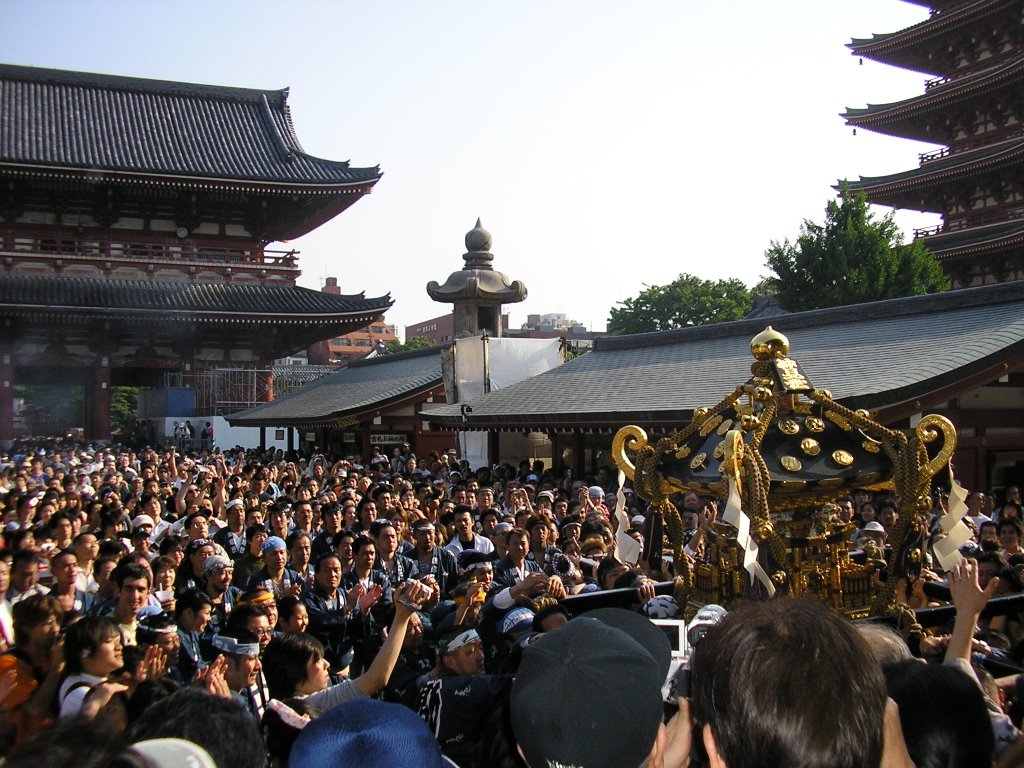
...and the legendary Sanja Matsuri...


...and I still have no idea what it's about.

Labels: , , , , , , ,