Wednesday, December 12, 2007

Sushi War

I return, drunker by far than I should be at this hour on a Wednesday, fresh from a midweek sesh with the clerk from one of my schools, who also happens to teach in the weekly assembly of studious foreigners and native Japanese volunteers I've been frequenting since September. Apart from a mutual love of Eberhard Weber, I have learned also of the profound battle between Sushi chef and customer.

Apparently (and bear in mind that at the time of writing, I am pretty damn drunk) when entering a sushi restaurant (a real sushi restaurant, not one of those Kaiten [conveyor belt] places frequented by plebs) the first thing one orders is Japanese style omlette, a.k.a yakitamago a.k.a gyoku. This is the initial yardstick by which the merit of the establishment is measured. The pernickity, overtly sadistic or just plain savvy customer will first examine the colour and aroma of this offering, then taste it. At this point, the chef, or sushi-ya-san will be fretfully awaiting the connoisseurs judgement. As an alternative to a speedy "bill please," the customer may decide that the gykou is good enough to warrant staying, at which point they will order hot sake

Relief for the sushi-ya-san!...for now...

There then follows a battle of the wills, both chef and customer testing the others depth of knowledge in this chosen battlefield. The customer will ask the chef to recommend the days special, a challenge which will reflect on the chef, as he no doubt chose the special himself from the fish market at some ungodly hour in the morning. This is a ritual battle with one victor. The cunning customer could potentially walk away from a sushi banquet fit for a Daimyo for as little as twenty-five quid, the alternative being twice as much if the sushi-ya-san works out that his opponent is in fact blagging it.

This confrontation with the chef is apparently typical of Japanese cuisine, and now this factoid has been imparted to me, it makes perfect sense. In most of the restaurants I've been to here, there is naught separating chef from customer but a modest kitchen counter. Here, the cook is completely responsible for what is served in their restaurant, with none of this hiding behind the double-swinging kitchen doors. If a customer doesn't like what they've been served, then the chef will answer to their complaints, before the entire shop if need be.

Diving deeper into the Japanese consciousness and acknowledging a profoundly militaristic culture, this practice presumably has its roots in the tea ceremony - Samurai, preparing to go into battle would have a nice cup of tea beforehand. Perhaps they had families and children. Perhaps they would go on to win a great victory for their Lord and lands. Perhaps they would die in trying. Perhaps this would be the last cup of tea they would ever drink. Better then, to make it the best cup of tea ever, before them, to make it with all the effort one would put into fighting for their home and to be answerable to ones comrades before death and glory.

It's funny and frustrating that I feel I'm only just getting a handle on this amazing country with only four months left of being here.

Labels: , , , , ,

Tuesday, May 29, 2007

Sushi Bar in Asakusa

For those of you viewing at work, volume isn't essential, but it adds something.

Labels: , , , , ,

Saturday, February 17, 2007

Product misplacement


Laugh? I seem incapable of stopping.

Labels: , ,

Tuesday, January 23, 2007

Japan in one day.

In recent months, both Hayley and I have experienced a profound disillusionment with Japan. Perhaps it's a symptom of homesickness, or maybe a comedown from the initial shock and thrill of being here. We have started making (elaborate) plans for a grand exit, but neither of us wants to leave Japan with such a nasty taste in our mouths. We've concluded that in order to depart in a good mood, we have to spend the rest of our time here behaving like tourists. I present you the extravaganza of saturday...

We woke up at the masochistic time of five in the morning, in order to visit the biggest fish market in the world at Tsukiji.


Breakfast was absurdly fresh sashimi from this place. Yum.

Tsukiji is also notable for Tsukiji Hongan-ji, a remarkably Indian looking Buddhist temple, reminding one of the religions' roots.


We found this to be a friendlier temple by far than others we've encountered in more touristy spots. Signs above pamphlets, declaring "It is free" or inviting visitors to look at the "beautiful golden altar" melt all but the iciest of hearts.


Also in the vicinity is the Hama Rikyu Teien, an ornamental garden, originally used as a duck hunting ground, now home to some very fat, un-hunted ducks.


All very lovely, but I prefer my parks a bit more rugged.

Our last stop, before collapsing in an exhausted heap, was Ginza, just up the road from the Imperial Palace, and one of the first places in Tokyo to Westernise. Ginza is certainly striking, but it's not one of my favourite places, mostly because of a certain snob factor. Ginza is the place to be seen. A former private student was what I dubbed a Ginza Granny - a moderately wealthy woman who likes nothing better than to put on her finest clothes and walk through Ginza, just to be associated with the place. For the dirtier visitor, like myself, there is little to keep one occupied, unless you relish the idea of buying a box of chocolates that costs the same as a CD.

Ginza is however, home to the SONY Showroom, exhibiting the very latest in life-devouring gadgets and toys, most notable of which were video cameras of a hyper-reality-dream-like brilliance, and a demo of the upcoming (and erroneously titled) Final Fantasy 13, which would have most definitely stopped me from graduating had it been released back then...the showroom was, sadly, bereft of robot dogs.

Also present was the latest offering from Nissan...


...apparently friendlier to the environment than your average fuel guzzler...but I didn't have a clue what the accompanying placard was talking about.

...all that done, we staggered home and watched a silly film. In the face of our recent gripes with this infuriating country, behaving like tourists had us enjoying and discovering things for the first time in a long time...expect more entries like this dotted about over the coming year.

Labels: , , , , , ,

Sunday, January 21, 2007

大寒 - Daikan

Literally "Big Cold", Daikan is the coldest part of the winter before spring, the period from the 20th of January until the 3rd of February, or Setsubun. Our saintly landlord came round last night with a large bowl of Japanese pumpkins. Apparently, if one eats pumpkins on the first night of Daikan, then catching a cold can be avoided all year round. Tune in at the same time next January, when the mettle of this tradition will be scrutinised.

Labels: , , , ,

Tuesday, January 16, 2007

Recovery & burnout

I'm cured!!! After a week of being pumped up with antibiotics (experiencing my first drug induced hallucination in a number of years) and gone at with the very latest in big syringe technology, I am all but empty of pus, capable of speech, laughter, and above all, that essential paving of the path to recovery, eating.

I look at my blog and see how neglected the poor dear has been. I also remember a time last year, brimming with bright eyed "I will be a writer!!!" earnestness, when I declared that I would update it every day, whilst maintaining no less than four others...oh foolish boy, where was that energy when you were at school? I've seen a significant drop in the quality of entries since that ambitious mission statement, so I am beating a retreat, back to the safety of the weekly post...and maybe more if I feel inspired...I thank you.

Labels: , ,

Friday, January 05, 2007

Of unprecedented generosity and unremitting bastardry

Last night, Hayley and I went to a banquet at the house of our venerable landlord, Tsuchiya san. On the menu was Sukiyaki, basically high quality beef, thinly sliced & cooked at the table in a pan of soy sauce and sugar with a variety of vegetables and tofu. It was huge. He also presented a massive dish of sushi, about fifteen varieties, so the negligible journey home was accompanied by an invisible orchestra of timpani.

Our host wasn't eating much, spending most of the night cooking for us. We felt a little self conscious about that, but he didn't mind, and informed us that he had to keep below a certain weight, for the good of his health.

The Japanese Ministry of Health has approved an equation for determining your relative height to weight ratio. I, for example am roughly 186cm tall, and I weigh 80kg. For the equation, you need to put a decimal point after the 100 for your height, and multiply it by itself, thus

1.86 x 1.86 = 3.4596

Then divide your weight by the answer above.

80 ÷ 3.4596 = ?

If your answer is between 20 and 24, then you are, by official Government standards, healthy. Myself scoring 23.12406 means I could be healthier, but I've always known that. Hayley (despite her adoption of my uncompromisingly large diet) is remarkably within the gap.

Given that it's a rarity for the Japanese to entertain at home, this was something of an honour, so we bought desert, in the form of dango and cakes shaped like fish, stuffed with soy bean jam. These, however, were immediately offered up before his Shrine to Inari, the Shinto Rice Deity, and his family Buddhist Temple, adorned with pictures of his parents. Buddhism and Shinto are intimately linked in Japan.

Tsuchiya san went on to talk about the history of Japanese Buddhism and how there is no religious conflict within the country. True, Christians were persecuted in the Edo period, but that probably has more to do with social, political and cultural factors, rather than being an ideological disagreement.

Tsuchiya san is a member of the Soutou sect of Buddhism, although his family has been traditionally associated with a different sect. He is enthusiastic about Soutou Buddhism because he feels it is the root of Japanese culture.

I may be accused of oversimplification by any Buddhists who might be reading, but Soutou Buddhism works on the principal that Buddha nature is inherent in everybody and everything, and it doesn't need to be attained, just harmonised with. Simple rituals, such as the Tea Ceremony, or Zazen, are intended to realise this clearness of mind and spirit. Soutou Buddhism has rules for every aspect of life, from opening doors to going to the toilet.

For a people famed for avoiding the direct and embracing the general, at least when it comes to communication, the Japanese can be sickeningly specific. This is understandable when one considers their complicated religion and language, where a slight mis-pronunciation can result in wildly different meanings, but the condition takes a near pathological twist when it comes to matters bureaucratic. Today, I have returned from the local ward office, defeated in my attempts to avoid paying a bill I don't think I should.

Humph...entries like this make me want to resurrect the late Blog of Anger...basically, Health Insurance is mandatory out here. When I arrived, my illustrious employers provided me with an insurance plan they recommended. Unfortunately, when it came to an old injury flaring up again, this proved to be as useful as a chocolate teapot. In order to avoid paying the catastrophic fees I incurred for a bout of tonsillitis earlier last year, I had no choice but to sign up for the National Plan...and how glad I am that I did.

I've complained about this in another entry, that an injury in need of therapy was provided with painkillers, but now it seems that they want me to pay for a years worth of cover, namely the first year I arrived, when I was on that money-pit advised by the bastards I work for. Today has been a bitter test of my Japanese and basic tolerance of mankind.

That was a bit of a tangent wasn't it? Didn't go anywhere other than complaining either...I seem to have lost touch with my Buddha nature.

Labels: , , , , , , ,

Friday, December 15, 2006

End of year party.

This time of year is the season for enkai, feasts, banquets, celebrations, drinking. Last night, a gaggle of elementary teachers I've been teaching English to for the past year or more, congregated at a Teppan-yaki restaurant not ten minutes away from home.

Teppan-yaki is that entertaining genus of Japanese food which requires you to cook it at your table on a huge hot-plate, the teppan. On a night as miserable as last, the very notion of sitting around a large hot thing and cooking food on it is very appealing.

Until last night, the most interesting food I've had out here has been okonomiyaki (cook it as you like it), a savoury pancake with a variety of fillings. My new love is monjayaki, essentially the same thing as okonomiyaki, but considerably thinner, not making a pancake so much as scrapings of thin batter with an intense flavour.

Whilst okonomiyaki and monjayaki are quite elaborate, what I really love about Japanese food is the simplicity. One "course" was a cabbage on the hot-plate, fried in butter. It might sound bland, but with a little sprinkle of dark vinegar, it was one of the high points. One other plus for Japanese style feasting is that it consists of lots of little dishes, often acting as ostentatious beer snacks.

Another feature of the enkai is vast quantities of alcohol. I will say no more on that subject.

Particularly pleasurable was the company, specifically the lady (of an indeterminate age) who is the ringleader of this operation. There are many reasons to admire her, an impressive command of English being the least. Her spirit of adventure has had her out of Japan every year for the past twenty, visiting a new country each time. To be as well traveled as her is something to aspire to. What I also like about her is that she's a strong and independent Japanese woman, which considering the reputation this country has for sexism and flouncy ladies, is refreshing.

Whilst waiting for the other ladies to don their glad-rags, she mentioned to me her disappointment in young people who abandon duty to their fellows, and focus on one path of work and goals. Although she is by no means elderly, it was interesting to hear this inversion of a common criticism.

How about you? Is there somebody you work with or you've met through work who you find inspiring, or is there anybody you want to bitch about?

Labels: , , , , , ,

Wednesday, November 22, 2006

In defence of English Cooking...the birth of a paradigm

I'm standing on the shoulders of a giant here, but it needs to be said.

At school today (a new one) I got chatting to the Kyoto Sensei (Vice Principal) about a variety of things, for example, whether or not England uses the Euro. He was surprised to learn that she doesn't, and I can understand that gap of knowledge - manners monetary bypass me deftly.

Something that has come to my attention frequently however, is how revolting English food is perceived to be. He approached me conspiratorially,

"Chris, I've heard that English food really isn't nice at all..."

I then went on to describe the joy of Shepherds Pie and the necessity of a gas oven.

The list is interminable. Who can beat a full English Breakfast? Yorkshire Puddings sailing across a sea of gravy to a continent of beef? Cheese & Pickle?

Japanese isn't a cuisine which uses herbs - maybe a shiso leaf underneath a piece of raw squid, but the emphasis is on the purity and freshness of ingredients. There, the cannon is loaded for a common volley. The perception of English food, much like one I've heard about curry, is that condiments and flavourings are used to disguise the taste of food, which in its basic form is unpalatable. English folk (vegetarians aside) know as well as I do, that a nice bit of chicken is only made nicer by a bit of Rosemary.

Boiled meat has noses turned up from all across the world, but I'm not sure that the Kyoto Senseis' opinion of English cooking stems from that, as Shabu Shabu, one of the pricier dishes over here, is high quality meat boiled in a tofu & seaweed stock.

Invariably, when two cultures meet, differences are talked over, and food is an obvious choice. I've yet to meet a Japanese person who isn't deeply suspicious of English food, despite being unable to name a dish apart from Fish and Chips.

Once an idea begins to put down roots, it's difficult to prune it without access to the right information. Rumours about the low quality of raw ingredients, requiring a list of condiments that themselves may be off-putting to the uninitiated (brown sauce?!) coupled with minimal opportunity to provide the accused with a fair trial, results in the poor image English cooking receives.

Then characters like Jacques Chirac denounce English cooking as second worst in Europe after Finnish. Proving, indubitably, that whatever our problems internationally, it's all the fault of the French.

Labels: , , , ,

Sunday, June 25, 2006

More English than the English?

The list of those sports invented by the English but now dominated by other nations is a lengthy one...

...so writes Jack Crossley in an imitation English newspaper that lined the basket of fish & chips consumed by Hayley & myself in the English themed Hub Pub of Kawasaki & sundry other neighbourhoods in Japan. Extending this idea towards food, even though the Japanese take on fish & chips is way off the mark, it is healthier by far than what one receives in Blighty. Does this make it better in the long run? In terms of coronary crises, one could venture a hearty "certainly", but I think they`re missing the point somewhat...

...short entry this week for a couple of reasons...

1) We`re off to see England play...some other country...Ecuador?

2) I`ve spilled beer on my laptop rendering it immobile for the forseeable future. Hopefully, normal service will be resumed shortly...

Labels: , , , ,

Sunday, March 19, 2006

Nomihodai

This is a very useful word to know in Japan - it literally means all you can drink. Nothing much more to say really. That was my St Patricks day, apparently huge in Japan, what with parades in Tokyo over the weekend, but I'm not going anywhere.

I was under the impression that four leaf clovers didn't exist (Jono, are you really Irish?), but, courtesy of my new friend (whose father is apparently about to release some muck on the Shell corporation drilling for oil in a protected coral reef), I've received one of the buggers. However, the blurry results yielded by my consistent attempts at photographing the thing (thanks to Hayley for the crispest image to date) has led me to the conclusion that it is ethereal, and probably a prank courtesy of the wee folk...

Labels: , , , , ,

Tuesday, February 28, 2006

As if we didn't have enough celebrations in February/March...

...my blog is exactly one year old!. Celebrating with bolognese...how about you?

Labels: , ,

Sunday, January 15, 2006

Oshogatsu

This is the Japanese New Year week, the most important night being the 31st (Omisoka), naturally. As Christmas has a status similar to Valentines day, this is the period to spend with your family, eat lots and watch TV.

They start the proceedings with Osoji; a massive clean and general tidy, so that the two most important days can be spent in a clutter-free environment. This is also in keeping with Shinto ideas of purification and renewal. Osoji is meant to appease Toshigami, the God of the New Year, who visits each house to give blessings to the family.


Hatsumode is a trip to a local Temple, such as Daishi in Kawasaki (pictured) on New Years Eve. Thousands of people are present at this occasion. At midnight, 108 bells ring, each one representing a different sin of the senses. The emphasis is on renewal.


I'm not going to go into Shinto in this entry (that's coming later) but there is a great deal of symbolism in a decoration/end of year meal called Kagamimochi. That specimen was bestowed upon us by our lovely landlord. It's sometimes called a Mirror Cake - the two balls are an image of each other, one representing the year to come, the other the past. Mirrors are often used as representations of the Kami (Shinto gods) in shrines...more on that later. Kagamimochi is sometimes also called Tooth Cake, as people would eat it, wishing they had teeth. After cracking the thing open and going at it with the very latest in big knife technology, I wasn't surprised.


It's basically a massive pounded rice cake. I was expecting an obstinate gloopy substance, not tightly a packed ball of wax. Our scepticism mounted at the same rate as the perspiration and furrows on my brow...then we toasted it.


They puffed up a treat, suddenly becoming much easier to eat, but not really taking on anything approaching a flavour. For the past week I've been surreptitiously finding out from my students how to eat the damn thing. People sometimes stew it with green leaves, fish paste and a manner of other ingredients depending on which part of Japan you're from, but grilling seems to be the most popular option. Once browned you can eat what you like with them; maybe anko (soy bean jam) but the suggestion by Sakuta sensei was to wrap them in nori with a bit of cheese.


Yum, yum and thrice yum. If anybody fancies getting a bit closer to Japan at this cultural high point of the year, why not have a go at this Mochi pounding game? It's fairly self explanatory (despite being in Japanese) - click the white blob on the pot (or any other white blobs that occur), select your character (man with hammer or kappa), red for hard, blue for easy and click the button next to your chap to play. The man has to pound the rice without hitting the kappa, whilst the kappa has to mix the rice without being lamped. Hours of fun and very Japanese.

Labels: , , , , ,

Sunday, January 08, 2006

Reverse Culture Shock

Being a tourist in your native country is an interesting experience, one I'd tried before on a pilgrimage to Canterbury via Oxford & Cambridge, but having been in Kawasaki for nine months, I noticed certain things that I'd forgotten about England, namely how beautiful the place is.

Something else I really enjoyed was eavesdropping on conversations. Any subject, no matter how trivial was music to my ears, more so when hearing two Londoners complaining about congestion charges - "Aaahw, it'll be push-boikes nex' wahnnit?" "Gor-blimey yer roight aintcha?" *

I was determined to sample uniquely English things one just can't find in Japan, namely English Breakfasts (the third one finally yielding that most elusive of beasts, the Hash Brown) and, something nowhere else in the world seems to do; pubs. Look in wonder at


The Tabard, Chiswick, London,


The Highbury Vaults, Cotham, Bristol,


and the legendary Duke of York, St Werburghs, Bristol.


Actually, my early pub experiences this year were worrying affairs, surrounded as I was by hordes of uncouth, vulgar, barbaric Westerners. Still, serves me right for drinking in Bolton.

Reverse culture shock is a peculiar old fruit - what I encountered in England was incredibly familiar, but somehow alien. Aspects of this were particularly pronounced when I returned to Japan, like the sheer volume of space back home, even in London. When I first came here I think I was still reeling from a host of other things, so I only gradually noticed how compressed everything is, it became mundane and I never noticed it. The trip to England has shown it in sharp contrast and made it almost surprising.

I read pretty much every advertisement on the London Underground, mostly due to delight that I actually could, but also down to the underlying crapness of English public transport. Maybe Japan has spoiled me with her optimum efficiency and subsequently aged me one or two decades, but really, pull your finger out Blighty.

Maybe the strangest part of being back in England was feeling rootless. Although it's "home", it isn't any more. Kawasaki isn't "home" but it's become that in another sense over a period of months. This is something I've read about, generally affecting expats, and confirmed by a Norwegian businessman I got chatting to on the way back to Japan. He's been going to Japan on and off for most of his life (he first arrived in 1960 on a propellor plane) and the place frustrates as much as it captivates him. ALT's who started working for my company at the same time as me had already been living in Japan, gone back to their country of origin, then returned, missing something about the place. As my travelling companion said, it becomes a part of you. Personally, it took me about a day to stop randomly bowing at people.


* "My Fair Lady"-isms may be products of the authors' excitement.

Labels: , , , , , ,

Saturday, November 19, 2005

When you're tired of Japan, you're tired of rice

I've been here for roughly seven months and seventeen days. I haven't written anything about the food yet. Rest assured, I am still me.

In keeping with Shinto values of harmony and purity, the Japanese diet depends a great deal on the seasons and the quality and freshness of the ingredients. Technical jiggery-pokery of rice aside, I think this attitude towards freshness is what makes Japanese sushi much tastier than that which I've encountered in Blighty. I'd be prepared to lay money on it being a reason why fruit and veg are so expensive here. Another possible explanation for the high price of greens is that what little workable farmland there is in Japan is mostly given over to rice. Rice yields more per unit of land than any other crop and so, in many ways, has formed the backbone of the empire. They can be quite nationalistic about their rice, sometimes proclaiming that it's the best rice in the world. I'll admit it's tasty, but you can't make a risotto with it.

The Japanese do a great deal of importing - from what I can gather, the indigenous diet mainly consists of rice, daikon radish, sundry mushrooms including shiitake (not pronounced "shite ache"), soy beans and fish. Shinto's spirit of harmony has created an assimilative culture - many "Japanese" dishes come from other parts of the world. Yaki Niku (cook your own meat) for example, is Korean in origin. The practice of frying food is, apparently, owed to China, and even Tempura, variously depicted as shrimp or vegetables deep fried in a thin batter, was introduced by the Portuguese Jesuits. I've asked some Japanese people what a typically Japanese (ie, with no external influences) meal consists of. Rice has been the first word on their lips. Everything else is merely an accompaniment; fish, maybe some lotus root...then they tend to trail off embarrassedly.

They're great believers in the natural flavour of food, hence their partiality to raw fish. Sauces are usually served as dipping condiments in separate dishes, and rarely mixed. My method of throwing anything I can find in a big pan and cooking it for hours at a time hasn't been expressed here, although I've found solace in Miso Udon - udon noodles cooked in miso soup, miso paste being a preserve of grain, salt and soybeans. Soybean jam is often the centre of Japanese deserts, wrapped in a parcel or ball made of ground rice, formed into a paste...yummy, sticky, fat and really healthy.

Regional variations of dishes are marked, but all local cuisines are represented in Tokyo and Osaka, the latter being the nations culinary capital. Osaka Takoyaki (octopus in balls of batter) and Okonomiyaki (savoury pancake made with cabbage and a variety of other ingredients, the name meaning "cook it as you like it") are considered the finest in Japan, although my beer addled brain chose to forget this gem of a factoid whilst I was actually there (sorry Matt). Kyoto is home to a variation of the aforementioned bean jam and rice cake, the rice parcel folded into a neat little triangle and coloured green, maybe with seaweed.

In the introduction to the edition of “Naked Lunch” that I’ve read, William Burroughs explains the term as the moment when you look at what’s on your fork (or nestling between your chopsticks) and suddenly realise what it is, where it’s come from and it’s relation to you. I’ve experienced the very antithesis of this several times since coming here, often looking at what I’m eating and thinking “what exactly is this?” I know that Surusuru is made with tofu, natto, raw egg, seaweed and…some bizarre white gloopy substance that generally befuddles me. It’s nice, but utterly impossible to eat with chopsticks. Natto itself is a classic weird bit of food - it’s fermented soy beans. If you can get over the fact that it looks like snot and smells like feet, it’s quite tasty, but again, eating it with chopsticks is an uphill struggle. Natto is almost a point of victory for the students when we’re talking about Japanese food and my enthusiasm for it - when we finally get to Natto and I confess that I’m not keen on it, I can almost hear them thinking “Ha-ha, we are inscrutable.” Despite the surface ickyness, Natto is one of the healthiest foods known to humanity. Japanese food as a whole is incredibly healthy, contributing greatly to their longevity and the resultant density of population...although the lack of habitable space probably has something to do with that also.

This next bit isn't for the faint hearted...

The expression “I’m so hungry I could eat a horse” is beautifully (or grotesquely) realised here - Lyle, another ALT, has told me about a place where you can ride horses in a lovely paddock, and finish up your day with a horse burger. I'm curious about eating horse, but as of yet, I've not tried it, and as for whale, I've only eaten it once - it's very expensive (you'd think they were endangered). My eating ethics have undergone a drastic shift over the past few years anyway, but more so since I came here - I’m not sure I would have eaten whale if I’d been told what it was beforehand, but since eating it and finding it to be incomprehensibly tasty, it’s made me re-reconsider a few issues. Lyle didn’t partake of horse burger, and I quite understand that - in the English speaking world we’re not brought up to consider these animals as food. The idea of a nice fat Sunday roast would be anathema to Hindus the world over.

I've heard stories about restaurants where you can eat tentacles cut from a live octopus. The fact that the twitching suckers attach themselves to your tongue is considered part of the taste experience There are places where you can eat whole fish, still wriggling. Now that's fresh. I’ve eaten whole (dead) fish since I’ve been here. Yes, their eyes were removed, but tuna heads are quite popular in Japan, the eyes being "the best bit". Whilst on that whale-munchin' night out with the Rinko staff, I partook of sashimi squid - this isn’t slices of squid lovingly laid out on a shiso leaf; this is a whole, albeit small, squid, complete with eyes and internal organs. There is nothing quite so alarming as the sensation of squirting squid guts when you’re not expecting it. Or when you're adventurously practicing your reading in a yaki niku restaurant and get served a dish of intestines. Even some Japanese people find that just a bit weird.

Love Japanese food as I do, they aren't really that into ovens...right now I am salivating at the mere thought of a baked potato with beans and cheese...mmmm...roll on Christmas.

Labels: , , , ,

Wednesday, September 07, 2005

...Kyoto part 2 & Osaka

We decided to have a butchers at the Imperial Palace. Having got up too late for the morning tour, we ended up having to kill time in the area waiting for the afternoon slot. Midst standing around going "lawks-a-mussy, it`s hot" we popped into Rozanji.

Rozanji

Not the most outstanding temple we saw, but it`s easy to get jaded with temples in Kyoto. The Imperial Palace didn`t strike me as being worth the wait either, despite the lovely garden bit...

lush

Imperial Palace

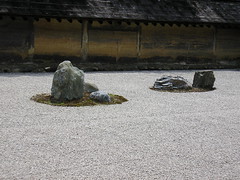
But no matter...off we went to Ryoanji,

a teensy bit of Ryoanji

which houses what is apparently the ultimate example of a Zen Rock Garden

Ryoanji rocks!

The allignment of the stones is supposed to have a different meaning for everybody who looks at them...I though they symbolised conflicting sides of human nature, a separation from the Divine and the means by which to return...Matt thought they were a bunch of rocks...

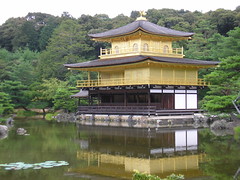
Then Kinkakuji.

Kinkakuji

I was especially keen to see this having just read "The Temple of the Golden Pavillion" by Mishima Yukio, based on the events of 1950 when the Temple was burned to the ground by a deranged Zen acolyte, obsessed with it`s beauty and his own ugliness. Mishima paints a gripping and I thought, contrary to whoever wrote the introduction, moving picture of his descent into madness. Cracking read, great writer. I`m currently tackling the tetraology he left at the publishers the day he committed seppuku in 1970.

But that`s all too heavy for an entry about holidays, & monkies are cuter by far than ugly Zen psychotics.

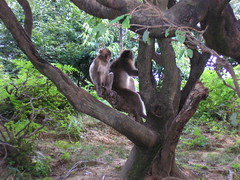
MONKIES!

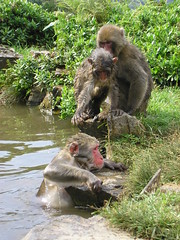
Man and monkey live in pseudo-harmony at Iwatayama Monkey park, a sort of reservation up a mountain west of Kyoto. Amazing experience, having never been that close to the things before. Whilst stopping to take this photo

wet monkey

one of chaps walked past my foot. Having lived with twenty-four cats at one point, animals at my feet are nothing strange...but a monkey?! Yay!

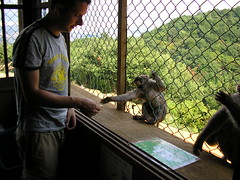
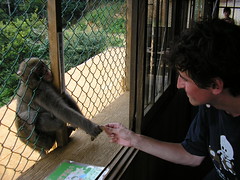
One of the best features about this place is the shack where the monkey-careres do all their admin, and tourists can feed them from behind a wire mesh. Nice reversal of the zoo scenario, the observers being on the inside...but of course, the monkies were observing us & our tourist trap bags of sweet potatoes.

Matt & monkey

Me & monkey

That last photo was taken with the uncanny skill and precision of Matthew John Falconer Banks, may his name be praised.

Having walked through a great deal of Kyoto and climbed a mountain, we decided our last day would be one of relaxation...we still ended up climbing a mountain though...

Kibune

Kibune is the kind of area that would be described in Bristol as "gert posh". As well as a couple of temples, it`s home to a number of Ryokan that open their doors to the general public from June until September, serving traditional Japanese food on tatami covered platforms over a river.

hmmm...I`ll have the fish please

Wow that was tasty...I read somewhere that it`s considered bad manners not to clean your plate, so when presented with a lovely ayu (FISH!), I proceeded to polish off every bit...the head was pretty tasty, but to all future ayu munchers, don`t eat the guts...

The second part of this trip, involving the aforementioned mountain hike, took us to Kurama.

Kurama...ain`t it nice?

Legend has Mount Kurama as home to the Tengu, goblins with red faces and gigantic noses. There was a statue of one of the beasties after the mountain walk which, sadly, I neglected to snap...those of you who know Matt can probably see the fellow.

At the very top of the mountain, as well as a stunning view of lots and lots of trees (don`t get many of those in Kawasaki) was the final temple we saw...

Kurama dera

...no more temples! Gaaaaaaagh!

Having climbed two mountains in just as many days, we decided the time was right for an Onsen...we had a warmer at a Sento, which is like an indoor Onsen...basically, you wash yourself thoroughly before getting into a communal bath which is REALLY HOT. Then you spend your time hopping between that and one which is REALLY COLD. Hours of fun...well, two at most, as you tend to turn into pudding after a while.

An Onsen is different from a Sento in that it is outside, up a mountain, and the bath is full of mountain spring water.

don`t you just want to jump in there?

I couldn`t resist it. Surrounded as I was by naked men, I thought it best to take a photo quickly and discretly. A pity I didn`t turn the flash off...

So that`s it for Kyoto. Matt was getting a plane back from Osaka,

...by night...obviously...

...and I wanted to go there anyway as it`s the home of The Boredoms, so I felt a pilgramage was in order...I found nothing to suggest that it was their home, but what I did find was an alarming number of Jehovah`s Witnesses.

Osaka is pretty industrialised, as it was virtually destroyed by American bombing in World War II...this of course has keft it open to garish advertisements...

on a ferris wheel

...and many an opportunity for daftness.

ouch!

Having being cultured out in Kyoto, Osaka was all about ending the holiday in the way that only two Bolton boys in Japan can...KARAOKE!

AGH!

As the songs line up at the same rate as the beer, I invariably turn into my mother. There we`re singing the Stone Roses "I am the Ressurection" at the top of our roaring northern voices.

Yay! My summer. What a blast. Having being financially ruined somewhat as a result, I spent the next two weeks living off a diet of rice and water & whatever I could catch with my bare hands. If anybody else fancies coming over...?

There`s probably not going to be an entry for a while, hence the inordinate fatness of this one. Thanks for your patience, and watch this space...

Labels: , , , , , , ,

Friday, May 13, 2005

Nihon no reigisaho - Japanese etiquette

Just before I start...I CAN use chopsticks. I can pick up individual grains of rice with the things. They`re like extra fingers. Of course, as soon as I go out for a meal with a couple of Japanese people, I turn into a meat-fisted clusterfuck. Very nice evening all round, courtesy of Komada sensei & Mrs Komada. Didn`t pay a bean, ate like an annual conference of kings.

I spent a good portion of my time before the meal learning a few Japanese phrases that I could drop into the conversation. This proved to be futile, as the whole evening was spent conversing in English, but I was determined not to let my efforts go to waste. I tried to use the phrase "Nihonjin wa aisoo no ii totemo desu" which, according to the Collins Pocket English/Japanese dictionary, means "Japanese people are very friendly." What it actually means (unless I pronounced it incorrectly) is "Japanese people are very cynical". I am reminded of the Monty Python sketch, where a Ukranian John Cleese is proclaiming loudly in a shop that his hovercraft is full of eels, and that his nipples explode with delight. Komada sensei tells me he had a similar problem when he was living in New Zealand. I reckon it`s a conspiracy to ferment inter-racial tensions, and what better place to hide it in than a billingual dictionary?

Neither of them were drinking, Komada sensei because he was driving, Mrs Komada because she`s a "sensitive" drinker, so I was doing my best not to let the conversation descend into a roaring drunken monologue on my part. I think I succeeded, but it`s hard to tell with Japanese people as they`re generally too polite to tell you if you`re being a fool or not.

The Japanese are incredibly polite. Too polite you might say. They always seem to be apologising. The word "sumimasen" generally means "excuse me", but it`s also a way of saying "thankyou" and a way of saying "sorry". A more serious way of saying sorry is "gomen nasai" but they have a third level of apology - "moshi wake gozai masen" which is the ultimate "I`m truly, unbelievably, utterly wretchedly sorry and I`ll never ever do it again". Even that`s not enough for a discrepancy that warrants this kind of apology, & it has to be backed up with repeated bowing and letters to various bigwigs saying you`ll endeavour to improve your behaviour. I`ve never had to do that...yet.

There`s nicer elements to Japanese etiquette. "Please" and "thankyou" are lovely words in any language. "Onegaishimasu" is a favorite of mine - at the start of each lesson the kids all face the front, bow solemnly and then there`s forty tiny voices screaming "ONEGAISHIMASU!!" I love that sound. Makes me grin like a loon. It`s the politest way of saying "please" - in the context of the lesson, I think the kids are saying "please teach us", whilst the teachers are saying "please learn from us"...or something. When put at the end of "dozo yoroshiku" (pleased to meet you) it makes it even more polite, "dozo" already meaning "please", when offering something.

There are four levels of saying thankyou - "domo", which is very informal (cheers); "hai, domo" which is more of a standard thankyou; "domo arigato", thankyou very much indeed and "domo arigato gozaimasu" which is something along the lines of "you have improved my life considerably by what you have done...YAY!" Of course, this was the first way of saying "thankyou" that I learned, so it slips off the tongue quite easily, often inappropriately (Wow! You sold me some socks! THANKYOU SO MUCH!).

I have no idea what`s being said in the teachers meetings at the start of each day, but I recognise enough words to know that before they launch into the issues they want to raise, the teachers are all roughly saying "excuse me please, thankyou for listening, I have a suggestion that I would be very grateful if you would hear, thankyou so much" - the speech is humble, but the manner is confident and businesslike.

That`s just the language. I`ll save day-to-day things for another entry. This one`s already too long, but in closing, for a moment I saw a hideous echo of myself in the writing style of this guy. Then I kept reading. Prelude to a nervous breakdown? I reckon.

Labels: , , ,

Wednesday, April 20, 2005

A moral cunundrum?

I ate whale for the first time tonight. I feel no guilt - it was delicious. Save the whales? Nah...

Labels: , , ,

Tuesday, April 19, 2005

The domestication of man...and the earth moved.

It is nearly complete. All I need is a washing machine & a hoover. Then I shall be set. The hoover should be pretty straightforward, the washing machine on the other hand is a veritable abyss of rectal agonies. It`s not quite as simple as buying one of the bastards & sticking it in your kitchen, heavens no. There`s a fitting in my corner & the machine has to be the exact dimensions, length, breadth and height. The recycle shops, be they cheap, are decidedly hit & miss on that particular front, so I don`t think I have any choice but to get a new one, which will set me back a good ¥150,000 at least. Bloody ouch...

On the plus side, I am now the proud owner of a gas stove (decidedly less sashimi for me), a rice cooker, a fridge and a kettle-keep-water-warm thing. Made my first home-cooked Japanese meal on sunday - rice with seaweed, daikon, sesame seeds, omlette, cucumber and raw tuna (yum). Minutes after I`d finished, I (well, not just me...the whole of Oda actually) had my first earthquake. How can I describe it without stating the obvious? I can`t. The entire house shook. A number of thoughts rushed through my brain as everything I own rattled ominously. "Ooo, that`s a large truck. No wait, it`s a big gust of wind. Hang on, someone`s trying to steal my flat with a crane!" What it was only occured to me after the dust had settled, so to speak. Ueno san tells me that there are many different types of earthquake. This one was definitely horizontal. Vertical earthquakes are, apparently, very terrifying indeed. Can`t wait.

Started at a new school today - my first impressions are that I prefer my other school, Kyomachi. Rinko is just a bit rougher. This is reflected by the teachers, who seem to fit into the stereotype of heavy-drinking Japanese. I was introduced, not in literal but definitely in no uncertain terms to the "spliff-making teacher". When making the universally recognised sign for "I am rolling a spliff", people are prone to exaggerate, but the space inbetween this mans hands was frankly ludicrous. My heart went out to the english teacher I was left with (for a while) as he can`t control the class and the kids have little or no respect for him. Then he recycled his (put bluntly, appalling [says the mega-experienced teacher with two weeks under his belt]) lesson plan for all three levels of student, regardless of ability, and that`s not even considering the fact that this lesson just involves the kids copying stuff out of a book - where`s the practice? Oh, I`m not going to talk shop...going out for a cathartic drink with the english teachers tomorrow night (On a school night? Yes. Oh. Okay.). Thankfully I have a Board of Education meeting the following day, which will involve the very friendly Sato san jabbering in Japanese whilst the other ALT`s who can`t speak Japanese & myself look on in wonder, & then HOME. Potentially a three day week, woo-hoo.

Whew, that was a fat entry.

Labels: , , , ,