Sunday, September 24, 2006

Anybody still there?
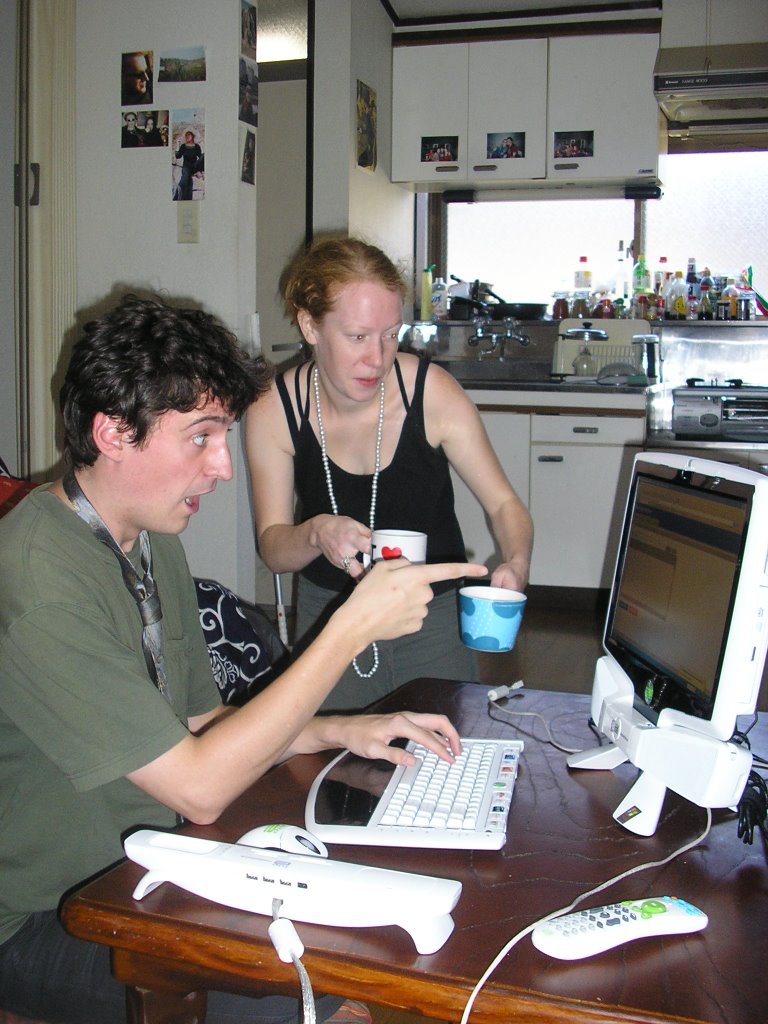
A World Cup ago, a truly inspired act of clusterfuckery resulted in the death of my faithful laptop, hence the inactivity here in recent months. The unprecedented generosity of my mother has bestowed upon us a shiny new beastie, which permits us, from the comfort of our home, to keep in more frequent touch with friends & family, refresh web & photoblogs on a regular basis, remain savvy with regards to the planet but most importantly, resume watching this.

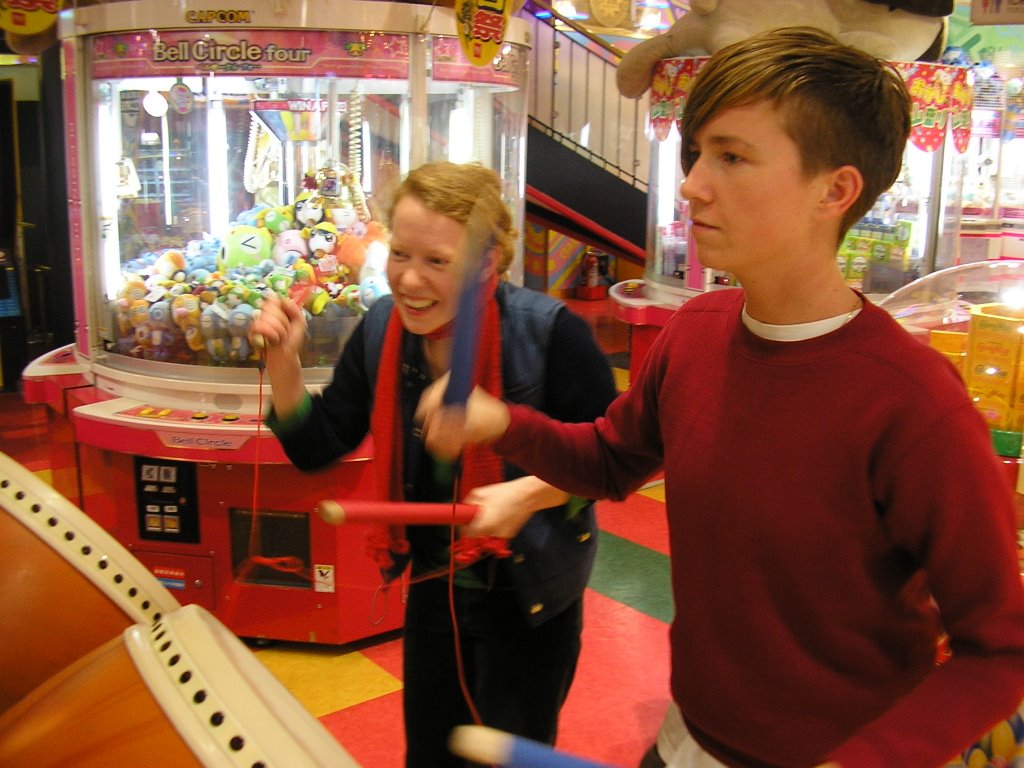
This sudden acquisition of a new computer took us both by surprise - thusly this weeks entry has about as much substance as what we did this weekend...tremendous fun, friday night was...a thirty-eighth birthday party in the heart of Tokyo, held in a popular bar, which sells 200 yen beers, although "beer" is a very generous description of what we were drinking that night.

Verily, 'twas a night of random encounters, perhaps the most entertaining being these two funny German fellas...

...and a gaggle of London girls, as it's always refreshing to hear an English accent this far away from home...that particular thirst was sated in a very surprising way whilst I was waiting for Hayley outside the station.

The Hachiko exit of Shibuya station is named after a certain dog, whose story echoes that of Edinburgh’s Greyfriars Bobby. The difference here is that the statue of Hachiko was erected before the death of the actual dog. Cynics have pointed out that maybe Hachiko didn’t visit Shibuya in order to wait for his departed master, rather to accept food from the people who had started recognizing him…but no matter…it’s a popular and convenient place to meet somebody in the madness of Shibuya.

Whilst I waited, I noticed a couple of Christians (specifically, Baptists, as I later discovered) wandering through the crowds, talking to people and trying to persuade them to come to church. Knowing what my answer would be, I tried to look inconspicuous, but non-Japanese tend to stand out over here. Naturally, I was spotted, and approached by a gentleman who, (well, I’ll go t’t’foot of our stairs) turned out to be from my hometown, sporting the delightfully Boltonian name of Roland. I found out later that his mother was Italian, his surname is “Franz” and that he’d been in Japan for about as long as I’ve been alive. I resisted the urge to point out that, in a sense, he represented the Axis powers of WWII, and did my best to avoid the subject of Theology. As far as people go, I liked Roland, and in a place like Tokyo, it was good to feel the “Bolton Kinship”, despite our wildly differing world-views. The crunch came when he tried to fulfill his mission and get me to Church, which was when I had to put my foot down and point out, without going into detail, the distance between our opinions.

Certainly, if I were to go to a Christian Meeting, I wouldn’t be able to do much, other than argue against their beliefs with the perseverance of a demolition worker, which I don’t really have the right to do…I think I surprised him with my refusal - although his face didn’t move a muscle, and he still kept his smile, there was the sensation of a sudden jolt, as if a pleasantly cruising vehicle in his head had just struck a solid object.

I wish him luck - although there are Japanese Christians, Shinto had deep roots long before Buddhism came over a century and a half ago…

Labels: , , , , ,

Monday, April 24, 2006

Shinto 3

So...the post WWII abolition of State Shinto & the Meiji declaration of freedom of religious belief has left Japanese spirituality with a colouful, if slightly vague, countenance.

Modern groups like Oomoto (with members such as Yamatsuka Eye of the Boredoms and founder of the martial art Aikido, Morihei Ueshiba) see the Divine in some very interesting places. They recognise not only notable figures from other religions as Kami, but also the creator of Esperanto, Ludwik Zamenhof. Esperanto being an attempt at a universal language, this suits the doctrine that the second leader, Onisaburo Deguchi, was a Messiah who would unite the world. Art is considered important to members, who believe that it brings humans closer to the Divine, and in a marked contrast to patriarchal Japan, Oomotos' spiritual leaders have always been women.

The group Soka Gakkai (influenced by the hardline Nichiren Buddhist sect) is Japans most powerful Buddhist sect. Accusations of intimidation and political corruption led to a reform in the laws regarding religious belief, eventually granting the Government greater powers of scrutiny in 1996. This move was fuelled mostly by the notorious Aum Shinrikyo cult, responsible for a variety of terrorist acts in Japan, culminating in the 1995 sarin gas attack on the Tokyo Metro. Since the arrest of their leader, the group has taken a more moderate approach.


Generally speaking though, many Japanese seem to regard religion as some sort of hat; borrowing traditions out of fancy. Pictured is Andy "I weren't doin' 'owt" Murray who, with his formidable Japanese skills, has a sideline as a fake priest, for those Japanese couples who want a Western style Wedding.


The truly wonderful thing about Japanese religion is that it's flexible and changes to fit modern life. One example is this rather incongruous looking building in the grounds of Kawasaki Daishi. It's a shrine dedicated to road safety, complete with a large car park in front of it, so the priests can bless vehicles en masse...naturally conjuring up images of men of the cloth standing at traffic lights with a bucket of holy water & a rag, frantically blessing windscreens & requesting donations from disgruntled drivers. Charms for road safety can also be bought at most Temples.

Shinto grows heads like a Hydra and gives birth to Gods with vigorous fertility. I read a story about a man in Higashiosaka who ran a shop selling herbal ear remedies next to a vacant lot that passing men would urinate into. He wasn't keen on that, so he erected two rocks and a shimenawa, to convince people that it was a sacred site, and ensure they wouldn't piss on it. After a while, people began leaving donations and asking him which particular Kami was enshrined. Fishing for an answer, he replied "the Kami of curing ear problems", and thus a new God was born. Over the years, the site, on a street leading to the Ishikiri Shrine, has become a small shrine in its own right.

Maybe in the 21st century, Shinto, or Japanese religion, has again come to resemble what it was before the arrival of other cultures; a folk religion, invoked when it's wanted, its lifeblood the cycle of festivals and observances that mark changing of seasons, coming of age ceremonies, and rituals to ensure good fortune.

Not really much more I can say about it except for this. Those of you who know me well will be aware of how much faith I put in statistics, but this one's a corker. Annually, the Agency for Cultural Affairs takes a census of religious groups and the members they have. Every year, the sum total of adherents claiming affiliation to a religion exceeds that of the national population.

So Japan...temples...Kami...Buddhas...what it's all really about is karaoke and beer - hurrah!


Yes indeedy, this past week we've been graced with the prescence of the lovely Rosie, giving us the chance to catch up, show her our favourite bits and me to take even more photos of Sensoji.


Thanks for coming over Rosie - it was great to see you...and as for the rest of you...we have a big flat by Japanese standards.

Labels: , , , , , , ,

Saturday, April 15, 2006

Shinto 2 - Born Shinto, die Buddhist

Japanese religion beautifully demonstrates their assimilative tendencies. I think I can safely say that the only genuinely Japanese phenomena I've encountered, are personality, rice and the ability to draw upon influences from the rest of the world and adapt them to suit the populace.

Shinto was only defined as a religion in order to distinguish itself from Buddhism... and to further muddy the waters, since Japans first encounter with writing was brought over from China by Buddhist missionaries, terms and concepts were taken from that religion and Confucianism, in order to express Shinto as a system of thought, but also to encourage a sense of national identity when dealing with foreign powers.

Buddhism and Shinto fused - sometimes, the Buddha is seen as a Kami, and by contrast, Buddha-hood can be seen as the state that all creatures, including Kami, aspire to. However, part of this assimilation resulted in Japanese Buddhism becoming very different from that which first arrived. Rather than contributing to Buddhist thought, it was adopted as a tool for Japanese society.

Generally speaking, the other-worldly-ness of Buddhism was at odds with the "here and now" of Shinto, since the latter traditionally didn't hold the belief of an afterlife. In order to catch on, Buddhism had to adapt to the ideals already in place. It had to change from being a world-denying to a world-affirming religion. Buddhism in Japan, with the idea of reincarnation, became death oriented, and probably struck a chord with ancestor worship. Funerals in Japan are traditionally Buddhist affairs, hence the title of this entry.

During the military dictatorship of the Tokugawa Shogunate (1603-1867), Buddhism was adopted as the state religion and used as a form of social control. A law required all families to register at a local temple, thus creating a network of government instituted parish organisations. Also, reforms in Japanese Buddhism couldn't exist as independent sects without prior permission from the state. This role made Buddhism quite unpopular during the Meiji resoration (1868-1912) when Shinto was declared as the state religion.

By contrast, Confucianism, also considered important by the Tokugawa, did a much better job of suiting the Shinto outlook, eventually influencing the Hagakure, the fabled code of the Samurai. Confucianism is an elitist philosophy, the governing body exercising a "Mandate of "Heaven", essentially a right to rule through Divine Providence. A key difference between Chinese and Japanese Confucianism is that this mandate can be "revoked" in the former (through political revolution or natural disaster, the fall of a monarch indicating that they were deemed unfit to rule), whereas the Japanese Emperors are the oldest unbroken monarchist line in history, despite their power being nothing more than symbolic in some periods. Notions of loyalty and political as well as personal obligation were particularly resonant, and continue to be so in contemporary Japan.

And that's not even mentioning Christianity, introduced by the Dutch & Portuguese. In keeping with its traditions as a religion of the persecuted, it hasn't exactly enjoyed a secure footing in Japan. This is probably because a great many Christian edicts fly in the face of Shinto, monotheism being a huge example. Not only does it dismiss the relevance of the thousands of Kami, but it removes the Emperors divine status. Christianity also places a strong divide between the mundane and divine, which with Shinto, exist in continuity with each other. On top of all this, Christianity seeks to change the social order by bringing about the kingdom of God, but perhaps most importantly, the positive, optimistic, life-affirming attitude of Shinto is dichotomous to the view of mankind born into sin.

With all this to contend with, it's a wonder that Christianity even scratched the surface of Japanese spirituality, but it does have a following here. During times of political strife, such as the Civil War (1482-1558), the Meiji period (1868-1912) and the post-WWII occupation (1945-1952), it's alien nature was seen as a great asset to people believing they needed a new outlook. That aside, the ideal of self sacrifice for the greater good is so Japanese you can taste it. Also, as some people in the West are fascinated by Oriental culture, the inverse is true in the East. Christianity has an appeal because of its associations with Europe, America, the West and modernity. There are also ethical reasons for converting - people who believe that these ideals create a person best suited to serve the nation, morally or, when dealing with other Christian nations, politically.

Every new arrival on the Japanese spiritual scene has had to appeal to the people themselves, thus making the Japanese religious outlook a hotchpotch of symbolism from several religions, and as if it couldn't get any more complicated, part of the Meiji restoration declared absolute freedom of religious belief...but I'm saving all that for the next entry...

Labels: , , ,

Sunday, April 09, 2006

Shinto

You would not believe the number of times I've tried to write this entry...Shinto (the way of the Gods) is a polymorphous, multi-headed beastie, and concisely defining it is a task Herculean in stature.


An indigenous form of Animism, it centres around the worship of the natural world and its elements, particularly those that inspire awe, such as mountains, waterfalls, dense forests, cloud formations, fire and even other human beings. These inspiring phenomena have associated, or are themselves "Kami"; divine beings.

Shinto isn't the sort of religion one can just convert to willy-nilly, not least of all because it has been known to emphasise the divinity of the Japanese people (surely, if not the root, then at least the soil of their cultural pathology), but also because it isn't really organised in such a way. It sometimes seems inappropriate to even describe Shinto as a religion. It's more of an attitude, an outlook, a way of seeing the world and behaving. An optimistic, positive view of an unspoken status quo that simply is. Shinto has no creed, no sacred texts, no attempts to win converts. Its life blood is a cycle of observances with an absurd amount of Gods. Although all the Japanese I've spoken to about Shinto wouldn't describe themselves as religious, they still take part in the array of festivals and ceremonies that are steeped in magical-religious ritual. This may also have something to do with the unquenchable group ethic.

The phrase "kuroshi toki no kamitanomi" (in times of trouble, turn to the Gods) sums up the Japanese attitude towards Kami worship. There are thousands of Kami, each one representing a different facet of life. If one wants a good yield of rice, then offerings must be made to Inari. Fisherman pray to Ebisu for a successful trip, whilst earthquake Kami must be appeased to avoid destruction of a new building for example. Such practices are still carried out in modern Japan. As late as 1972, many Japanese people relied on an almanac, highlighting days with a proclivity towards bane or blessing, in order to plan activities for the coming year. Organising a wedding for one of the days marked "Butsumetsu" (Buddhas' death) would be disastrous, as would holding a funeral on "Tomobiki" (bring a friend).

In Shinto, or Animism in general, there is a continuity between the mundane and the divine, blurring the edges between the sacred & secular. As you'd expect, the Japanese have a definite hierarchy based on the benefits each Kami brings to man. In Japans' agricultural past, Kitsune, the fox messenger of Inari, was considered particularly important. Kami such as this, along with the more malevolent variety, had to be appeased in order for man to live in harmony with nature, another Shinto ideal. Sin is equated with disease, natural disasters (of which Japan has its share) and other such calamities, created by a failure to appease the deities.

The standard creation myth (from the earliest records of the nation, the Kojiki and Nihongi) has Japan being made by Izanagi no Mikoto (creator or welcoming God) and Izanami no Mikoto (creator or welcoming Goddess). This creation was entrusted to them by the other Heavenly deities.

From the Floating Bridge of Heaven, they dipped the Heavenly Jewelled Spear into the ocean. The brine that dripped from the spears point became the island of Onogorojima (located near one of the two Poles if you want to be specific), where the two were wed. Izanami gave birth to the islands of Japan, along with thirty-five other deities, but in bringing forth the Fire God, she was horrifically burned and died. Some versions of the story have the Gods of metal, earth, water and youthful reproduction being born from her excretia.

In an attempt to rescue his beloved, Izanagi ventures into Yomi no Kuni, the land of the dead. Echoing Orpheus, he looks upon Izanamis' face, despite her pleas for him not to. Greeted with her scorched features, he flees, pursued by the minions of the dead and escapes, blocking the entry to Yomi no Kuni with a huge boulder, thus separating the two lands.

Tainted and defiled by his journey, he bathes, this act eventually taking form in the many Shinto purification rituals. From each drop of cleansing water, a new deity is born - the Gods of the moon, oceans or storms (depending on which version you're reading) and most significantly Amaterasu Omikami, the Goddess of the sun. It is Ninigi, a descendant of Amaterasu, who receives control of Japan. History and myth become one in Ninigis' grandson, Jimmu, the first historical Emperor of Japan.

That's not quite Shinto in a nutshell...although on the whole, it's a fairly shapeless affair, it became the state religion during the Meiji restoration of the late 19th & early 20th century. Also, other religions have put down roots in the Japanese spiritual make-up, the incalculable influence of Buddhism, which gave Japan its first system of writing, being just one example...but this entry's already massive and it doesn't get any simpler...


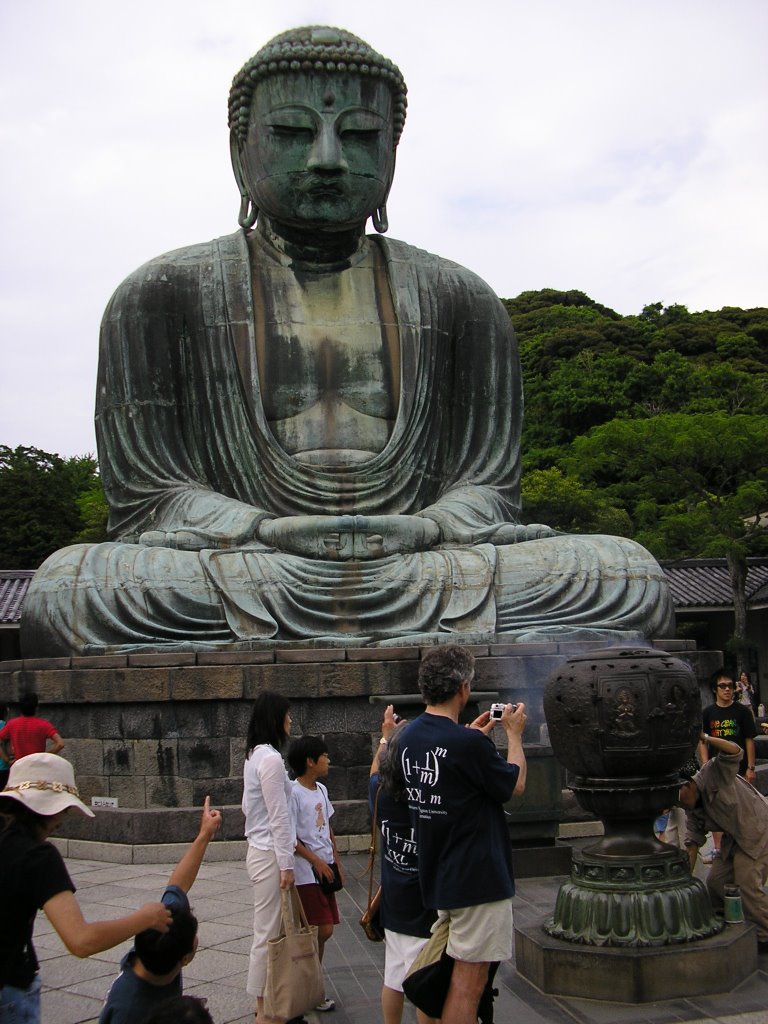
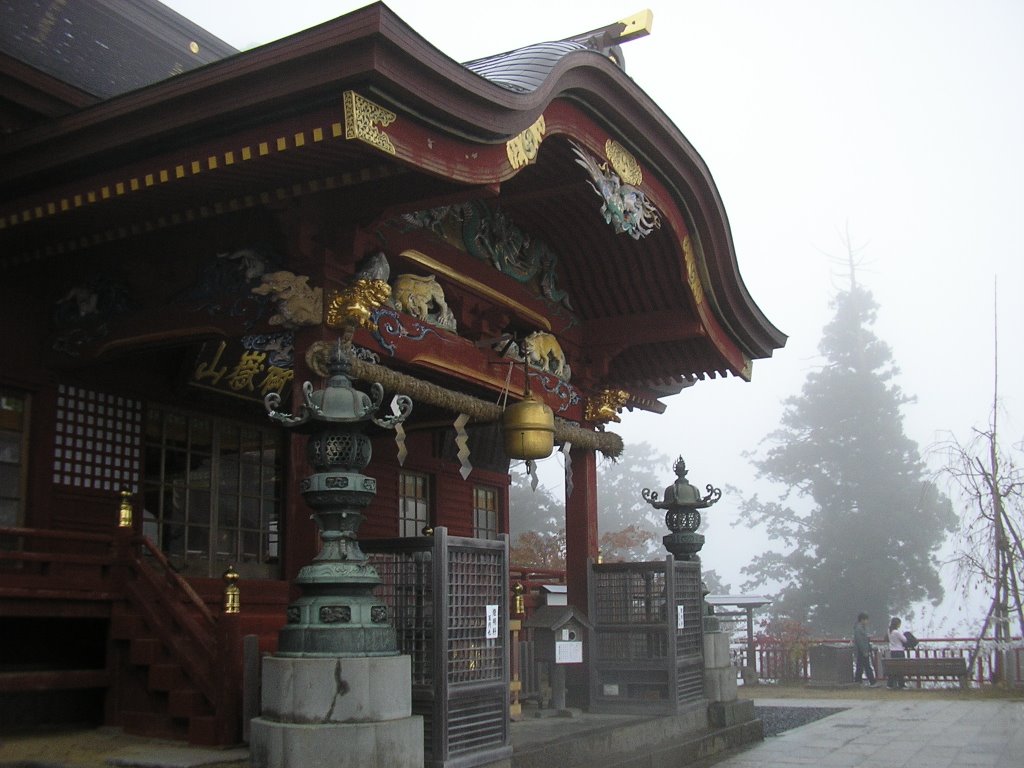
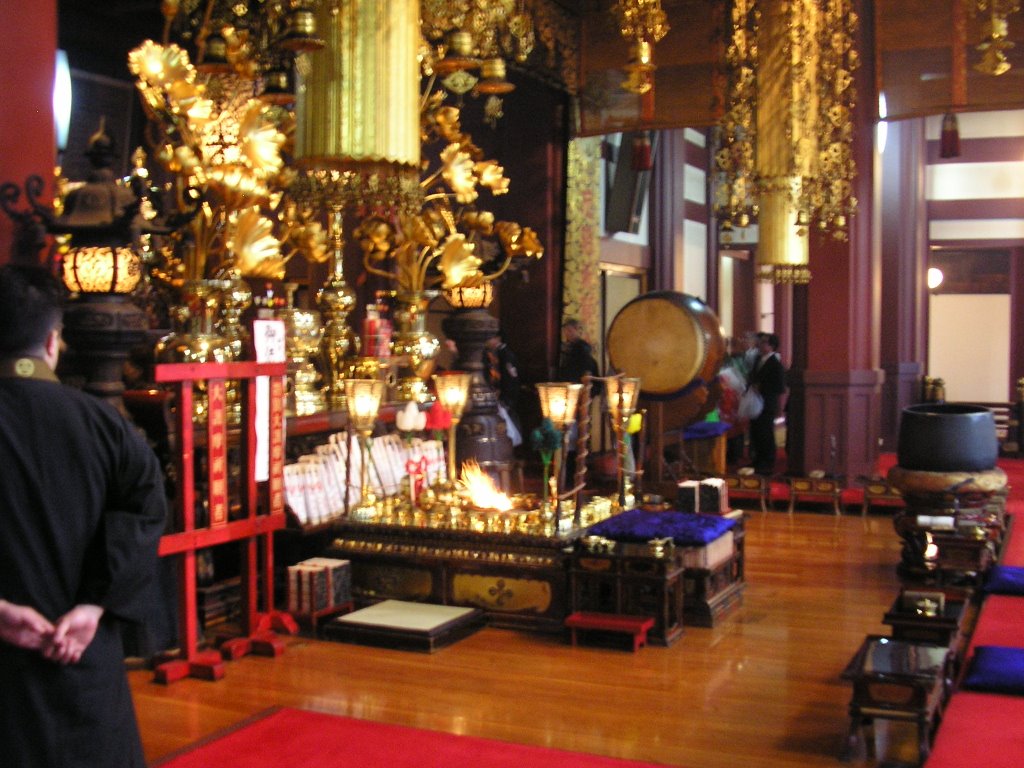
Photos from Mount Mitake, Kawasaki Daishi & Sojiji, Tsurumi

Labels: , , ,

Friday, February 03, 2006

Setsubun

Light of a firefly, snow on windows
Many years of reading, we passed
We found now our years of school finished
This morning, we have to say good-bye

source

Poignant time of year this - the third graders have finished their entry exams, many now knowing which High School they'll be going to, some still aren't so sure. The past few days have seen a few haughty swaggers into the teachers room, and some shattered slouches.

But exam results aren't half of the trauma of leaving school. As I've mentioned before, the Japanese word for friend, tomodachi, has some deep implications. The Elementary and Junior High schools you go to are determined by the area you live in. This means that unless your family has moved at some point in your school life, you are going to have the same classmates for ten years, and you will do pretty much everything with them. Now people who've known each other for almost their entire life go in separate directions. Maybe I'm being soppy...perhaps teaching isn't the career for me if I'm faced with nostalgia every year.

Anyway, loosely connected, tomorrow is the first day of spring, today being the titular Setsubun. On this day when the new season begins, a ceremony called Mamemaki is performed, where toasted soy beans are tossed in and out of houses to the cry of

Fuku wa uchi
Oni wa soto


meaning "good luck in, bad luck (Oni, demons) out". Of the beans one tosses indoors (representing good luck) the number corresponding to your years must be eaten to assure good luck. The beans are toasted in order to kill any demons within. There are apparently many stories that describe the origin of this ritual, all of them ending with an Oni being chased out of a persons house by having beans thrown at them.

I was invited by some first graders observing the custom to their home-room during lunch, and provided with a little origami box of beans to fling out of the window - supremely good fun it was too, although I was concentrating so much on my pronunciation that I very nearly threw the good luck beans out & the bad ones in...oopsy...

One could write endlessly about the apparent contradictions in Japanese society, famed for their super-refined technology, yet carrying out a magical-religious ritual hundreds of years old...I suppose when you think about it, that sort of thing is common in the West (ie, Holy Communion, although Christians may dispute my use of the term "magical"). I think what differentiates the two rituals is attitude towards belief and approach towards ceremony. As their teacher said, she isn't religious, but she observes the custom because it's fun.

That's an outlook on religion I've seen many times since coming here, one I find incredibly interesting. Religion in Japan is an almost shapeless mass of tradition; no Canon, no Scriptures, no attempts to win converts or save the damned - just a recognition of continuity between all things and the need to co-exist in harmony...I'm quite excited by what I've read about Shinto, possibly the very core of what makes them so...well, Japanese...but I'm saving that for another entry...so I'll leave you with an enigmatic ellipsis...

Labels: , , , , , ,